A child’s room has to do more jobs than almost any other room in the house, because it is a bedroom, a playroom, a library, and a homework spot all in one small space, and the best kids room ideas start from that simple fact instead of from a shopping list. This guide gives you ten practical ideas that work in real American homes, from low storage a small child can actually reach to bunk beds, reading corners, homework desks, and soft lighting, with real sizes in inches and feet, honest prices in dollars, and the safety details that matter when the room belongs to a child.
Before you buy anything, watch how your child uses the room for a few days, because the toys that end up on the floor, the books that get read again and again, and the corner where homework actually happens will tell you what the room needs far better than any catalog photo. Plan the room in zones — sleep, play, read, and work — keep the things your child uses every day low enough to reach, keep the floor clear enough to play on, and leave one wall or corner free to change as your child grows, because a room that can change a little each year will last far longer than a room built around one age.

A bright kids bedroom with a wooden bunk bed, a dresser with a lamp, a striped rug, and bunting strung by the window.
Table of Contents
- 1. Put Storage Low Enough for Small Hands
- 2. Choose a Bunk or Loft Bed That Earns Its Floor Space
- 3. Make a Small Reading Corner by the Window
- 4. Give Homework Its Own Desk Zone
- 5. Pick Colors That Can Grow With Your Child
- 6. Lay Out a Shared Room So Each Child Has a Side
- 7. Use Wall Decals Before You Commit to Paint
- 8. Organize the Closet at Kid Height
- 9. Layer Soft Light for Bedtime
- 10. Hang a Display Wall for Art and Achievements
1. Put Storage Low Enough for Small Hands

A kids bedroom with gray bunk beds and open shelves holding a few toys beside a rug, with the lowest shelves easy to reach.
The single rule that makes a child’s room stay tidy is that storage must sit where the child can reach it, because a bin on a high shelf is really a bin for the parent, and a child who cannot reach a toy cannot put it away either, so cleanup becomes your job every single night. Keep everyday toys, books, and games on low open shelves or in low cubbies, about 24 to 36 inches off the floor for a toddler and up to 48 inches for a school-age child, and use six to eight big bins at most, one for each broad group like blocks, cars, dolls, art supplies, and dress-up clothes, since a dozen tiny boxes only means a dozen decisions at cleanup time and a dozen lids left on the floor. Open shelves work well for books and a few favorite toys, because a child can see what is there and choose without pulling everything out, while lidded bins are better for small parts like building sets, which scatter fast and hurt bare feet; a low cube shelf unit costs about $60 to $150, a set of six fabric bins runs $20 to $40, and picture labels on the front of each bin let a child who cannot read yet still know where things go. Put the things that are used every day at the front and at hand height, move outgrown toys and off-season clothes to a high closet shelf or a labeled bin in another room, and keep the floor clear in the middle, because a room with a clear rug and low, open storage invites play, while a room with storage stacked to the ceiling invites a mess that nobody wants to start cleaning.
2. Choose a Bunk or Loft Bed That Earns Its Floor Space

A kids bedroom with a gray bunk bed, a small desk and chair by the window, and open shelves on the wall.
A bunk or loft bed is the fastest way to win back floor space in a small room, because stacking two beds uses the footprint of one, and the space you save can become a desk, a reading corner, or simply open floor to play on, which is why bunks are the first thing most parents look at when two children share a room or one child needs a desk in a room that already feels full. Safety comes before style here: the top bunk is generally meant for children aged six and up, the guardrail should run the full length of the top bunk and stand at least 5 inches above the mattress, the ladder should feel solid underfoot and be fixed to the frame, and the mattress should sit well below the top of the rail so a child cannot roll over it in sleep, while the ceiling needs at least 30 inches of clear space above the top mattress so the top sleeper can sit up without hitting their head, which usually means an 8-foot ceiling or higher. A basic wood or metal bunk bed costs about $300 to $800, a loft bed with a desk or storage built underneath runs $500 to $1,200, and stairs with drawers built into each step cost more but replace both a ladder and a small dresser, which is a fair trade in a tight room. Give each sleeper their own clip-on reading light, about $10 to $20, and a small shelf or pocket organizer on the rail for a book and a water bottle, keep the ladder clear of toys at all times, check the bolts once a month for the first few months since bunks loosen with use, and let each child pick their own bedding color, because a bunk that feels personal gets slept in happily, while a bunk that feels like a camp bed gets argued over every night.
3. Make a Small Reading Corner by the Window

A nursery with a dark wood crib, a gray armchair and a floor lamp by the window, and a patterned rug underfoot.
A reading corner does not need a built-in window seat or a special chair, because one comfortable seat, good light, and books within arm’s reach are enough, and the photo shows the idea clearly: a soft armchair beside a window, a floor lamp for the evening, and a rug that marks the spot as a place to sit and stay. Put the chair near a window if you can, so daylight falls across the page, and add a floor lamp or a small table lamp behind and slightly to one side of the chair, with a warm 2700K bulb, so evening reading does not mean a bright overhead light that wakes a sleepy child up again; a small bookcase or a set of low picture ledges beside the chair, about $30 to $80, holds the current favorites face-out, which matters because young children choose books by their covers, and a basket on the floor holds the rest. Keep the corner simple on purpose, with one chair, one light, and one small shelf, because a corner crowded with pillows and decorations leaves no room for the reader, and a child who has to clear a space before sitting down will simply read somewhere else, usually on the bed with the light off. For more ways to shape a quiet spot for books, these cozy reading nook ideas use the same move-first, shop-second order, and once the corner is in place, let your child help choose the books that live there, since a shelf a child helped fill gets used far more than a shelf an adult filled alone.
4. Give Homework Its Own Desk Zone

A kids bedroom with a pink desk and chair, a single bed with pink bedding, white wardrobes, and framed pictures on the wall.
Every school-age child needs one place to do homework that is not the bed, because work done on a bed is work done half asleep, and a small desk zone gives homework a clear start and a clear finish, which makes the evening routine shorter for everyone. Place the desk near a window when you can, so your child gets daylight for reading and writing, and keep it away from the main play area and the television, since homework loses to toys and screens every time it has to compete with them; a desk about 42 to 48 inches wide holds a laptop or books, a lamp, and a pencil cup without feeling cramped, and a chair that lets your child’s feet rest flat on the floor, with the desk top roughly at elbow height when seated, keeps shoulders relaxed instead of hunched. Storage is what makes or breaks a desk zone, so add a shelf above the desk for books, a drawer or a small tray for pencils and paper, and a pinboard for timetables and reminders, and keep the surface mostly clear, because a clear desk is far easier to sit down at than a desk that needs ten minutes of tidying first; a simple kids desk and chair set costs about $80 to $250, a desk lamp with a warm bulb runs $20 to $50, and a small set of desk trays costs $10 to $25. Set one house rule and stick to it: when homework is done, the desk gets a two-minute reset, with books stacked, pencils back in the cup, and papers in one tray, so the next day starts at a clean desk instead of yesterday’s mess, and keep chargers and school bags on a hook right beside the desk, so nothing homework-related has to live on the bed or the floor.
5. Pick Colors That Can Grow With Your Child
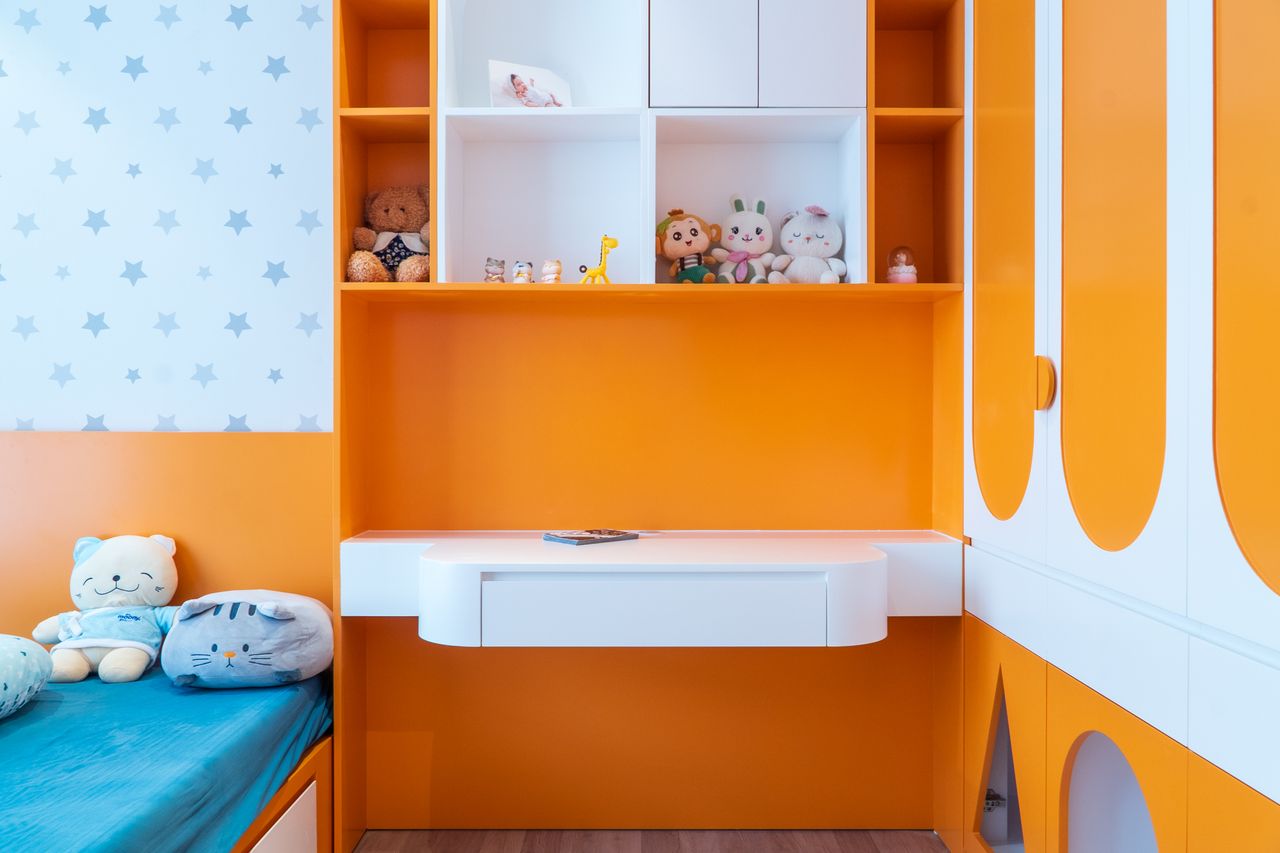
A bright kids room with orange walls and shelves, a blue bed, a white desk, and star-patterned wallpaper.
Bright color is what makes a child’s room feel like a child’s room, but the mistake most parents make is painting every wall in a loud theme color that a ten-year-old will hate, so the smart move is to keep the big surfaces calm and let the color live in things you can change cheaply. Start with walls in a soft neutral, a pale blue, a warm white, or a light sage green, and then bring in the bold color through bedding, a rug, curtains, and a few accessories, because a $30 set of sheets and a $50 rug can change a room’s whole mood in an afternoon, while repainting four walls costs $150 to $400 in paint and supplies and a full weekend of work. The photo shows the bold end of the scale, with orange shelves and a blue bed, and it works because the furniture is simple and the color is concentrated in a few big blocks rather than scattered across every surface; if your child loves that look, copy the idea with one painted accent wall or one bright piece of furniture, and keep the other walls plain so the room does not feel loud at bedtime. Pick a palette with two main colors and one accent, keep the ceiling and trim white so the room stays bright, use washable paint on the walls, since fingerprints and scuffs are part of life in a child’s room, and test a color on a poster board first and look at it in morning and evening light, because a color that looks cheerful at noon can look dark and heavy at 7 p.m., which is when your child is actually trying to fall asleep in it.
6. Lay Out a Shared Room So Each Child Has a Side
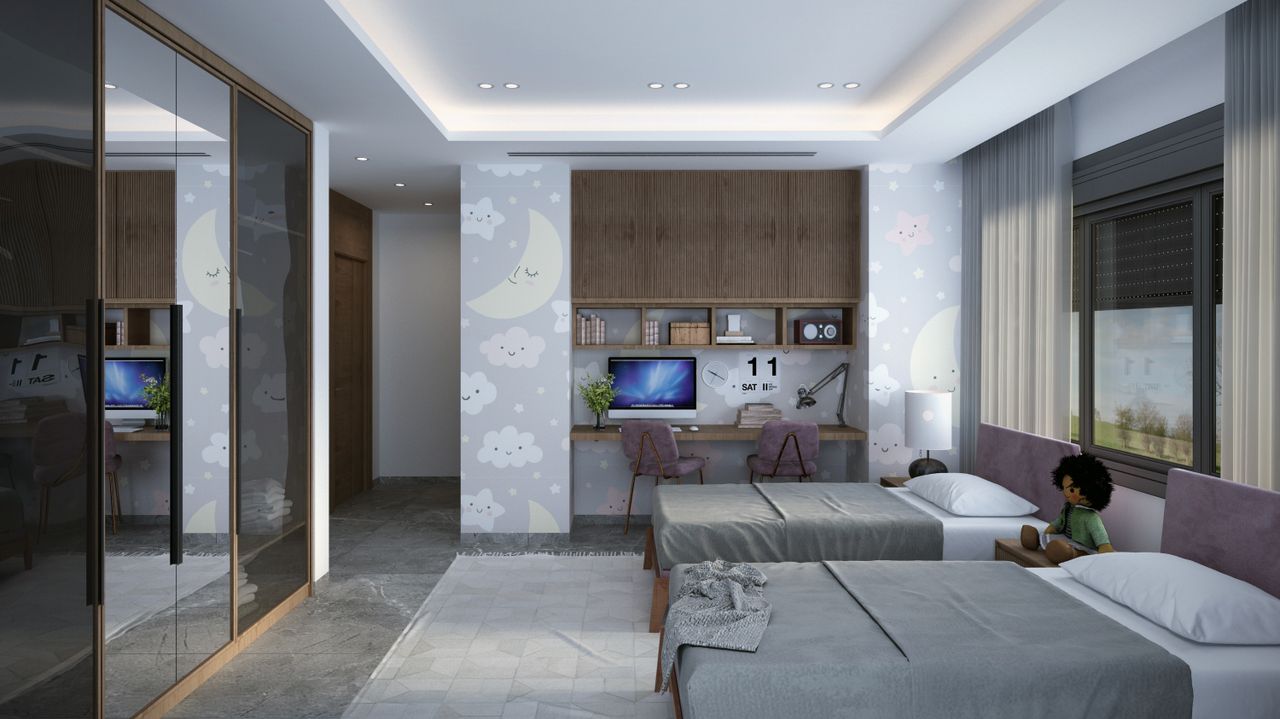
A shared kids room with two beds, a double desk with two chairs, moon and cloud wallpaper, and mirrored wardrobes, with a doll on the bedside table.
Two children in one room works best when each child can point to a side and say that part is mine, because most shared-room arguments are not really about toys or noise, but about feeling crowded out of the only room they have. Start by giving each child their own bed, their own small shelf or nightstand, and their own light, and then split the rest of the room down the middle: a rug in the center for shared play, a desk each or one long desk with two chairs, as in this photo, and a clear line down the closet, with each child’s clothes on their own side and different colored hangers so there is no morning argument about whose shirt is whose. Bunk beds are the classic answer when floor space is tight, but two twin beds can work just as well if the room is wide enough: each twin is about 38 inches wide, so two twins plus a shared nightstand need roughly 94 to 100 inches of wall, and you still want at least 24 inches of walkway on each outer side, so measure before you buy, and check what a normal size bedroom looks like to see whether your room can hold that layout or whether a bunk is the kinder choice. Keep the shared things in the middle — the rug, the bookcase, the toy bins — and the personal things on each child’s own side, let each child choose their own bedding color within one shared palette so the room still looks like one room, and agree on one simple rule together, such as quiet voices after lights-out, because a layout that gives each child a corner of their own turns a shared room from a daily negotiation into a place both children actually like coming back to.
7. Use Wall Decals Before You Commit to Paint

A white toddler bed with a teddy bear on the rail and an owl wall decal with small hearts on the wall above it.
Children change their favorite things fast, and a wall that is easy to change is worth more than a wall that is perfect for one year, which is why peel-and-stick decals are the best first step for a child’s room: they go up in minutes, come off without damaging the paint, and cost about $10 to $40 for a set, while a painted mural or a full wallpapered wall costs $100 to $500 and takes a weekend to undo when tastes change. Decals work best on smooth, clean walls, so wipe the wall down first, press each piece on from the center outward to push out air bubbles, and keep them above the height where small hands can peel them off during play, or accept that a few will get peeled and keep the spares that come in the pack. Use decals to make one feature wall behind the bed, like the owl and hearts in this photo, or to mark zones, with stars over the reading corner and animals over the play area, and if your child loves the look after a few months, that is the time to commit to paint or wallpaper on that one wall, since you will know the theme has staying power instead of guessing. For pattern ideas that work the same way, these kids wallpaper ideas show how one patterned wall can carry a whole room, and the same rule applies either way: one strong wall, three calm ones, and nothing glued or painted where a growing child will have to live with it for years after they have moved on.
8. Organize the Closet at Kid Height

A white closet with hanging clothes on a low rail, shelves of folded clothes, and bags stored on the upper shelves.
Most kids’ closets fail for one simple reason: everything is hung and shelved at adult height, so the child cannot reach their own clothes, and getting dressed becomes a job for a parent every morning. Fix it by hanging a second rod at kid height, about 36 to 42 inches off the floor for a young child, which roughly doubles your hanging space without touching a wall, and costs about $15 to $30 for a hanging rod doubler that needs no drilling; put everyday clothes on the low rod, move dressy clothes, off-season clothes, and keepsakes to the top shelf, and keep shoes in a low cubby or on a floor rack where they can be seen and grabbed. Give each drawer one job — one for shirts, one for pants, one for pajamas, one for socks and underwear — and use picture labels on the drawer fronts for younger children, so getting dressed and putting laundry away both work without reading. Keep one bin on a closet shelf for outgrown clothes, and the moment something is too small it goes straight in, so the closet never fills up with clothes that no longer fit, and clear the closet out completely before you organize it, because no system works in a closet that is already full. A few stackable fabric bins on the closet floor, about $20 to $40 for a set of six, hold sports gear, dress-up clothes, and spare bedding, hooks at your child’s height hold backpacks and jackets, and the whole closet becomes a place your child can actually use alone, which is the real goal: a room where a seven-year-old can get dressed, find their shoes, and put their laundry in the hamper without asking for help.
9. Layer Soft Light for Bedtime

A wooden loft bed wrapped in warm string lights, with a small desk and chair below and soft cushions on the lower bed.
Light is what turns a child’s room from a playroom into a bedroom at the end of the day, and the trick is to have more than one kind of light, so you can turn the brightness down in stages instead of switching from full daylight to total darkness in one click. Start with a main ceiling light on a dimmer if you can, then add a warm bedside lamp or a clip-on reading light for stories, and finally a small night light, about $10 to $25, that stays on all night, because a child who wakes at 2 a.m. and can see the shape of their own room is far less likely to be scared than a child who wakes in the dark. String lights, like the warm lights wrapped around the loft bed in this photo, are a favorite for older children, and they work well as a soft evening glow, but use battery or low-voltage LED strings only, keep them out of reach of small hands, never use real candles, and keep all cords tucked behind furniture and away from the bed. Choose warm bulbs around 2700K for every lamp in the room, since cool white light feels like an office and makes it harder to wind down, put the night light on the opposite side of the room from the bed so it glows without shining in your child’s eyes, and keep screens off for the last hour before bed, because a room that dims slowly, with a story under a warm lamp and a small light left on for the night, is the simplest sleep routine there is, and it costs less than $50 to set up from scratch.
10. Hang a Display Wall for Art and Achievements

A green wall with framed pictures hung above a white bed — this photo shows an adult bedroom, but the same picture-wall idea works in a child’s room with their own drawings and photos.
Every child makes things they are proud of, and a display wall is where that pride gets to live, instead of on the refrigerator for a week and then in a drawer forever. Pick one wall, or one stretch of wall above the bed or the desk, and hang a few picture ledges, about $15 to $30 each, or a simple wire with clips, about $10 to $20, so artwork can be swapped in seconds without new holes in the wall every time; mix your child’s drawings and paintings with a few photos, a medal, or a school certificate, and keep the frames simple and matching, because matching frames make a wall of very different pictures look calm instead of messy. Put the display at your child’s eye height, not at adult height, so they can actually see and reach their own work, and set a simple rule for changing it: when a new picture goes up, an old one comes down into a keepsake box, so the wall stays fresh without growing into a cluttered collage that nobody looks at anymore. Keep the best pieces and photograph the rest before they come down, since a phone photo of a drawing keeps the memory without keeping the paper, and rotate the display every month or two, because a wall that changes is a wall a child keeps looking at, while a wall that never changes becomes invisible within a week, and the whole point is for your child to walk into their room and see, every day, that the things they make matter enough to hang on the wall.
Frequently Asked Questions
What size room does a child need?
A room of about 10 feet by 10 feet, or 100 square feet, works well for one child, with room for a twin bed, a dresser, a small desk, and a rug for play. Two children sharing need at least 10 feet by 12 feet, or a bunk bed to free up floor space, and at least 24 inches of clear walkway around the beds.
What age is a bunk bed safe for?
The top bunk is generally meant for children aged six and up. Younger children should sleep on the bottom bunk or in a single bed, and any bunk needs a full-length guardrail, a solid fixed ladder, and a mattress that sits well below the top of the rail.
How do I keep a child’s room tidy without nagging?
Keep storage low, use six to eight big bins with picture labels, and keep only about a third of the toys out at a time, with the rest stored away and swapped every few weeks. A five-minute reset before bed, with everything back in its labeled home, works better than a big cleanup once a week.
Should I paint a child’s room a bright color?
Keep the walls calm and put the bright color in bedding, rugs, and curtains, which are cheap to change. If your child loves a bold color, paint one accent wall or one piece of furniture, and use washable paint, since fingerprints and scuffs are part of life in a child’s room.
How can I make a small child’s room feel bigger?
Use a loft or bunk bed to free the floor, keep furniture low and light-colored, use one big rug instead of several small ones, and store out-of-season clothes and spare toys outside the room. A mirror opposite the window also bounces daylight deeper into the room.
Final Thoughts
The best child’s room is not the one that looks perfect in a photograph, but the one that works on an ordinary Tuesday: a bed that is easy to make, toys that a child can find and put away alone, a book within reach, and a desk that is clear enough to sit down at without a cleanup first. That kind of room is built from small, honest choices, not from one big shopping trip, and it grows a little each year as your child grows.
Start with the problem that bothers you most, whether that is toys on the floor, mornings that take too long, or homework that never has a home, and fix that one thing this weekend, with low bins, a second closet rod, or a small desk by the window. Then let the room change slowly, one idea at a time, because a child’s room that grows with its child will always feel more loved, and more lived in, than a room that was finished all at once.
Sources
- Apartment Therapy: 20 Kids Room Storage Ideas
- Addicted to Organization: 55 Shared Bedroom Ideas for Kids in Small Spaces
- Clean Organized Family Home: How to Organize a Kid’s Room
- The Coolist: Shared Kids’ Room Layouts That Fit Two Beds
Gallery

A bright girls bedroom with a white canopy house bed, shuttered windows, a small pink chair, and shelves with toys.

A kids room with blue built-in wardrobes along one wall, a loft bunk above, and a desk nook with shelves underneath.

A nursery with a fabric teepee, a white crib, a play mat, and a rug in soft neutral colors.

No comments:
Post a Comment