A one-piece toilet fuses the tank and bowl into a single ceramic unit — no seam, no gap, nowhere for grime to hide. Shoppers choose it for the sleek look and the easier wipe-down, and it has become the default pick for modern renos across Canada.
This guide covers what you are actually paying for, how it compares with the classic two-piece and the wall-hung alternative, plus the measuring and rough-in details that decide whether it fits your bathroom.

Photo: Charles & Hudson via Wikimedia Commons
Table of Contents
- 1. What “One-Piece” Actually Means
- 2. The Seam Is the Whole Story
- 3. Cleaning Takes Half the Time
- 4. They Suit Small Bathrooms
- 5. Wall-Hung Is the Other Modern Option
- 6. Concealed Cisterns, Explained
- 7. Comfort Height Is Worth Considering
- 8. Add a Bidet Seat Anytime
- 9. Dual-Flush Saves Real Water
- 10. Measure the Rough-In Before You Buy
1. What “One-Piece” Actually Means

Photo: Eugenio Hansen, OFS via Wikimedia Commons
The tank and bowl are cast as one continuous piece of vitreous china, so there is no joint between them at all. No bolts, no rubber gasket, no ledge where the two parts meet — the silhouette runs smooth from the top of the tank down to the base.
Many models also hide the trapway (the S-shaped channel at the back) behind a skirted panel, which gives the sides a clean, flat surface. The look is noticeably more modern than the stepped profile of a traditional two-piece.
2. The Seam Is the Whole Story

Photo: Wolfmann via Wikimedia Commons
On a classic two-piece, the tank bolts onto the bowl with a rubber gasket between them, leaving a seam and a hard-to-reach gap behind. That gap collects dust, cleaning spray residue and — let’s be honest — things you’d rather not think about.
The gasket is also a future leak point; when it dries out years from now, the tank has to come off to replace it. A one-piece simply eliminates that joint. If you are renovating on a budget, our budget-friendly small bathroom ideas show where the two-piece still earns its place.
3. Cleaning Takes Half the Time

Photo: Wolfmann via Wikimedia Commons
Ask anyone who owns one: the real luxury of a one-piece is the wipe-down. One smooth exterior surface, no crevice between tank and bowl, and on skirted models nothing to snake a brush around at the back. A weekly clean takes minutes instead of a chore.
Inside the bowl, the routine is the same as any toilet — brush, a non-abrasive cleaner, and never bleach on a regular basis since it dulls the glaze over time. The time you save is all on the outside.
4. They Suit Small Bathrooms

Photo: Wolfmann via Wikimedia Commons
Compact one-piece models run about 60 to 66 cm deep, versus 70 cm or more for a standard two-piece — those few centimetres matter in a powder room or a tight ensuite. Many also have a lower, sleeker tank profile that keeps sightlines open. Check our half-bathroom size guide to see how they fit typical Canadian layouts.
Still respect the clearances: building code generally wants about 38 cm of clear space on each side of the bowl’s centre line and 53 cm in front. A smaller toilet does not excuse a door that can’t swing past it.
5. Wall-Hung Is the Other Modern Option

Photo: Rama via Wikimedia Commons
If you love the seamless look, also consider wall-hung: the bowl floats off the floor and the cistern hides inside the wall, so mopping underneath takes seconds. It is the easiest toilet in the world to keep clean around.
The catch is the installation. It needs an in-wall carrier frame rated for 180 kg or more, which means opening the wall and usually hiring a plumber — installed cost runs two to three times a one-piece. For most renos, the one-piece is the simpler value play.
6. Concealed Cisterns, Explained

Photo: Acabashi via Wikimedia Commons
A concealed cistern is the tank hidden inside the wall (or inside a vanity unit), operated by a flush plate on the wall. It gives you the floating-bowl look with nothing visible but the plate — very popular in European-style Canadian condos.
Plan for an access panel: every concealed cistern eventually needs a new fill valve or seal, and a tiled-over tank with no access turns a $50 part into a demolition job. Insist your contractor leaves a proper service opening.
7. Comfort Height Is Worth Considering

Photo: Wolfmann via Wikimedia Commons
Most one-piece models come in comfort height — a seat 43 to 48 cm off the floor, versus 38 to 40 cm for a standard-height bowl. Taller users, anyone with knee trouble, and seniors find it noticeably easier to sit and stand.
The only downside is for small children, who may need a step stool. If you are styling the rest of the room too, our powder room decor ideas work around whichever height you choose.
8. Add a Bidet Seat Anytime

Photo: Benlisquare via Wikimedia Commons
Most one-piece bowls accept an aftermarket bidet seat, which is the easiest way to get warm-water washing without replacing the toilet. The one requirement people forget: a GFCI electrical outlet within about a metre of the toilet.
Bidet seats run $400 to $1,200 CAD, with heated water, a warm-air dryer and a remote. If your bathroom has no nearby outlet, budget an electrician visit before you fall in love with the idea.
9. Dual-Flush Saves Real Water
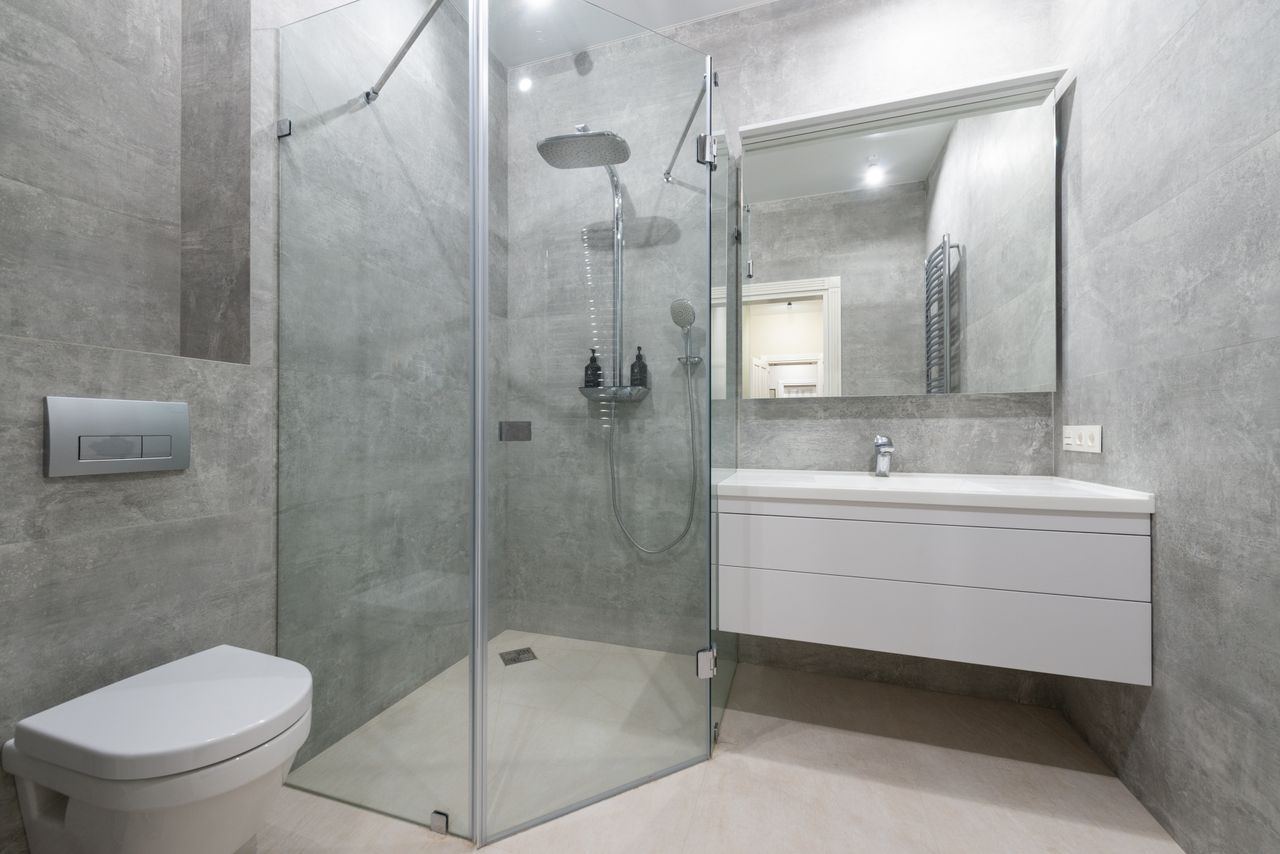
Photo: Max Vakhtbovych via Pexels
Nearly every one-piece sold in Canada today is dual-flush — typically 3 litres for liquids and 6 for solids — replacing old 13-litre guzzlers. Look for the WaterSense label, which certifies a maximum 4.8 litres per flush on the full flush.
In Toronto, where water is metered, a family of four can save roughly 30,000 litres a year switching from an old toilet. That is real money on the utility bill, year after year.
10. Measure the Rough-In Before You Buy

Photo: Sarah Stierch via Wikimedia Commons
The rough-in is the distance from the finished wall to the centre of the floor flange bolts — 30.5 cm is the Canadian standard, with 25.4 and 35.6 cm existing in older homes. One-piece models come in fewer rough-in options than two-piece, so measure before you shop.
Moving a rough-in means cutting the floor and reworking the drain: easily $1,000 or more. A straight swap by a plumber runs about $200 to $400 CAD. See our bathroom renovation costs in Canada for the full budget picture.
Frequently Asked Questions
How much does a one-piece toilet cost in Canada?
Expect $300 to $900 CAD at Canadian retailers for a good one-piece, $1,000-plus for designer models, and $200 to $400 for professional installation.
Are one-piece models harder to repair?
The working parts — fill valve, flapper, flush valve — are standard and easy to replace. The difference: if the ceramic itself cracks, you replace the whole unit instead of just the tank.
Do one-piece models clog more easily?
No. Flushing performance depends on trapway design and glazing, not piece count. Look for a fully glazed trapway at least 5 cm wide for the best clog resistance.
Can I install one myself?
It is one heavy lift — 40 to 55 kg — but doable with a helper, a new wax ring and a level. Hire a pro if the flange is damaged or the floor needs levelling.
One-piece or wall-hung?
Choose one-piece for value and a straightforward install. Choose wall-hung for the cleanest look and easiest floors, at two to three times the installed cost.
Final Thoughts
A one-piece toilet is one of those upgrades you notice every single day — in how the bathroom looks, and in how little time cleaning takes. The premium over a two-piece is modest, and the seamless design ages well.
Confirm your rough-in, pick comfort height if anyone in the house has creaky knees, and leave an outlet near the toilet in case a bidet seat calls your name later. Small decisions, daily payoffs.
Sources
- Orton Baths: One-Piece vs Two-Piece Toilet — Which Is Better?
- Bathroom Wiki: Toilet Types — Pros and Cons
- Angi: One-Piece vs Two-Piece Toilets
- Riverbend Home: The Difference Between a One-Piece and a Two-Piece Toilet
Gallery
Photo: Jonas Thomann via Pexels

Photo: Posh Living, LLC via Wikimedia Commons

Photo: NPS Photo via Wikimedia Commons

No comments:
Post a Comment