10 King Bed Pillow Arrangement Ideas That Always Work
A king bed is 76 inches wide, and that big, empty space is exactly why so many king beds look flat and unfinished, even with nice bedding. The good news is that you do not need a designer's eye to fix it. A good king bed pillow arrangement follows one simple rule: the biggest pillows go at the back, the smallest go at the front, and every layer has a job. Once you know the counts and the sizes, you can copy any look in this guide in about two minutes each morning.
Below you will find ten proven formulas, from a neat hotel stack that takes seconds to a full nine-pillow luxury look. Each one lists the exact pillows you need, their sizes, and the order to place them, back to front. Most use pillows you probably already own, and if you do need to buy a few shams or inserts, each setup costs roughly $40 to $100 to complete at stores like Target, IKEA, or Amazon.

Photo: Wikimedia Commons
Table of Contents
- 1. The Classic 3-2-1
- 2. The Hotel Stack
- 3. The Simple 2+2
- 4. The Euro Wall
- 5. The Bolster Finish
- 6. The Layered Luxe Look
- 7. The Neat Minimalist
- 8. The Romantic Pair
- 9. The All-White Layers
- 10. The Relaxed Lean
- Frequently Asked Questions
- Final Thoughts
- Sources
- Gallery
1. The Classic 3-2-1: Euros, King Shams, and a Lumbar

Photo: Wikimedia Commons
This is the formula designers use most, and the numbers are right in the name: 3, 2, 1. Stand three Euro shams (26 x 26 inches) against the headboard. Three of them side by side measure 78 inches, which spans the full 76-inch width of a king bed with no sad little gaps at the edges. In front of the Euros, stand two king shams (20 x 36 inches) — these usually hold your sleeping pillows, so they earn their keep. Finish with one long lumbar pillow (14 x 36 inches, or 12 x 48 inches for a really wide look) centered in front. Six pillows total, tallest at the back, shortest at the front.
Keep the color story simple: let the Euros carry a pattern or a deeper color, keep the king shams close to your duvet color, and let the lumbar add one texture, like linen, velvet, or a chunky knit. A set of three Euro shams costs about $15 to $25 each at most home stores, and the inserts run $10 to $15 each. If your Euros are down or down-alternative, give each one the famous "karate chop" — a quick downward swipe in the middle of the top edge — so they look plump and styled instead of slouchy.
2. The Hotel Stack: Sleeping Pillows in Flat Pairs

Photo: Wikimedia Commons
Ever notice that hotel beds almost never have throw pillows, yet they still look crisp and inviting? This is their trick. Take four king sleeping pillows (20 x 36 inches) and lay them flat, in two stacks of two, one stack on each side of the bed. Pull the duvet or top sheet smooth over the mattress and fold the top edge down once for that clean hotel band. That is the whole arrangement — no shams, no accents, nothing extra.
The Hotel Stack is the fastest formula on this list to make and the easiest to live with, because at night there is nothing to remove. It works best in all-white or mostly white bedding, where the neat stacks and smooth lines do the styling for you. A second pair of king pillows costs about $20 to $40, and the look stays fresh if you wash the white cases weekly and give each pillow a good shake and fluff when you make the bed. If flat stacks feel too plain, stand the top pillow of each stack upright at a slight angle instead.
3. The Simple 2+2: King Shams and Two Accent Pillows

Photo: Wikimedia Commons
If you are new to styling a bed, start here. Prop two king pillows in shams (20 x 36 inches) against the headboard, one on each side. Then place two square throw pillows (20 x 20 inches) in front of them, again one on each side, standing upright with the corners pointing up. Four pillows total, perfectly balanced, and the whole bed instantly looks deliberate instead of flat. This is also a great everyday formula for couples, because each person only moves one throw pillow at night.
The two accent pillows are where your personality goes. Pick covers that pull one color from your rug, curtains, or wall art, and mix one pattern with one solid or textured cover so the pair looks collected, not matched. Throw pillow covers cost about $12 to $30 each, and you can swap them with the seasons — linen in summer, velvet or plaid in fall — while the shams behind them never change. Keep the inserts one size bigger than the covers (a 22-inch insert in a 20-inch cover) for full, firm corners.
4. The Euro Wall: Big Squares Across the Headboard

Photo: Wikimedia Commons
For a tall, full look with zero fussy extras, build a wall. Stand three Euro shams (26 x 26 inches) across the headboard, then stand your two king sleeping pillows (20 x 36 inches) directly in front of them. Five pillows, two straight rows, and not a single throw pillow in sight. The tall back row hides the gap between the mattress and the headboard, and the whole bed reads as one solid, plush block of pillows — perfect if you like to sit up and read or watch TV in bed, because that Euro wall is genuinely good back support.
This formula shines with a tall or upholstered headboard behind it; if yours is low or plain, our tufted king bed guide shows the styles that pair best with high pillow arrangements. One buying tip that makes a real difference: Euro inserts are often sold a little soft, so choose an insert labeled 28 x 28 inches for a 26-inch sham. The extra fill pushes into the corners and keeps the wall standing straight instead of slumping by midday.
5. The Bolster Finish: One Long Pillow in Front

Photo: Wikimedia Commons
A long, low pillow in front ties a wide bed together like nothing else. Build the back layers first: two king shams (20 x 36 inches) standing against the headboard, with your two sleeping pillows either inside them or standing just in front. Then lay one long bolster or lumbar across the front — a cylinder bolster (about 9 x 36 inches) or a long lumbar (14 x 36 inches or 12 x 48 inches). Boutique hotels sometimes use two shorter neck rolls side by side, as in the photo, which gives the same unbroken line across the bed. Total count: five pillows.
The bolster is the hardest-working pillow here. All day it is the finishing line that makes the arrangement look complete, and in the evening it is the perfect support behind your back for reading or under your knees for relaxing. Bolsters and long lumbars cost about $20 to $40 with the insert, and because there is only one front pillow to move at night, this formula takes about ten seconds to undo — a big reason it suits busy households.
6. The Layered Luxe Look: Nine Pillows for a Big Statement

Photo: Wikimedia Commons
This is the full luxury-hotel pile, for people who love a bed that looks like a magazine photo. Work back to front: three Euro shams (26 x 26 inches) against the headboard, two king shams (20 x 36 inches) in front of them, two square accent pillows (20 x 20 or 22 x 22 inches) in front of those, and one long lumbar (14 x 36 inches) centered in front. Your two sleeping pillows can hide behind the Euros or sit inside the king shams. That is eight to nine pillows in four tidy layers, and on a 76-inch-wide bed there is honestly room for all of it.
With this many pillows, discipline matters more than the count. Stay inside two or three colors from your bedding, and repeat each fabric at least twice so the layers feel planned — for example, linen Euros, cotton shams, velvet accents, and a knit lumbar. Be honest with yourself about the nightly routine, too: nine pillows need a home at night, so give them a bench, a big basket, or a chair before you commit. If that sounds like too much, drop the accent pair and you land right back at the Classic 3-2-1.
7. The Neat Minimalist: Sleeping Pillows Only, Done Right

Photo: Wikimedia Commons
Minimal does not have to mean bare. Use four king sleeping pillows (20 x 36 inches) and nothing else: either two neat flat stacks of two, or all four standing in one straight row against the headboard with their flanges aligned. Fold the duvet down by about a third to show a clean band of sheet, smooth every wrinkle out with the flat of your hand, and that is it. The styling here is precision, not decoration — straight edges, even spacing, and pillows plumped to the same height.
This is the best formula for small bedrooms, hot sleepers, and anyone who hates the nightly pillow shuffle, and it costs nothing beyond the pillows you already sleep on. It only works if the basics look good, though: cases should be clean and bright, and pillows that have gone flat or lumpy need replacing (about $15 to $30 each for decent king pillows). One colored throw blanket folded at the foot of the bed is allowed, if pure white feels too plain for you.
8. The Romantic Pair: Two Shams and Two Pretty Throw Pillows

Photo: Wikimedia Commons
For a soft, romantic bedroom, keep the shapes simple and let texture do the talking. Lay two king sleeping pillows (20 x 36 inches) in shams against the headboard, slightly reclined rather than ramrod straight. In front, place two decorative square pillows (18 x 18 or 20 x 20 inches) with a romantic finish — ruffles, rosettes, embroidery, lace trim, or a faded floral print — centered as a pair. Four pillows total, and the bed looks dressed without looking stiff.
Soft colors carry this look: blush, cream, ivory, pale sage, or dusty blue, with the two feature pillows as the most detailed pieces on the bed. It is a forgiving formula for beds without a statement headboard, because the eye goes straight to the pretty front pair. At night, stand the decorative pair together on a nightstand or chair — never on the floor, where delicate fabrics pick up dust and lose their shape fastest.
9. The All-White Layers: One Color, Lots of Texture

Photo: Wikimedia Commons
An all-white bed never goes out of style, and the layering keeps it interesting. Build three rows, all in white or warm ivory: two king shams (20 x 36 inches) at the back, two standard or king sleeping pillows (20 x 26 or 20 x 36 inches) in the middle, and two square white cushions (20 x 20 inches) in front. Six pillows, one color family. Because there is no color contrast, the eye reads the shadows, seams, and fabrics instead — and that is exactly what makes it look expensive.
The secret is mixing textures so the layers do not melt into one white blob: a smooth cotton sham, a slubby linen cushion, a matelassé or waffle-weave pillow, maybe one with a subtle flange or pintuck detail. All-white bedding is also practical — everything can be washed together, and whites can handle a hot wash that keeps them bright. If the result feels a touch stark, one folded throw in a soft neutral at the foot of the bed fixes it without breaking the calm.
10. The Relaxed Lean: Pillows at an Easy Angle

Photo: Wikimedia Commons
Not every beautiful bed is perfectly symmetrical. For a relaxed, lived-in look, lean instead of stack: prop two king sleeping pillows (20 x 36 inches) against the headboard, lean two Euro shams (26 x 26 inches) in front of them at a soft angle so they rest against the pillows rather than standing at attention, and drop one lumbar (12 x 24 or 14 x 36 inches) loosely in front, slightly off-center if you like. Five pillows, nothing squared away, and the bed looks inviting instead of staged.
This style pairs naturally with washed linen bedding, rumpled cotton quilts, and casual rooms where a formal arrangement would feel out of place. Skip the karate chop here — a gentle fluff and a lean is the whole technique, which makes it the fastest of the layered looks to rebuild in the morning. If the lean keeps sliding flat, your inserts are too soft; firmer foam or well-filled down-alternative Euros hold an angle much better than worn-out ones.
Frequently Asked Questions
How many pillows should be on a king bed?
For sleeping, two king pillows are enough for most couples. For a styled look, most king beds carry six to nine pillows in total, counting shams and accents. Fewer than five tends to look sparse across a 76-inch width, and more than nine usually crowds the bed and makes the nightly routine a chore. If it takes you more than about 30 seconds to clear the bed at night, you probably have too many.
Where do all the decorative pillows go at night?
This is the question almost every pillow lover asks, and the answer is: give them one proper home. A bench or trunk at the foot of the bed, a large basket in the corner, or a bedroom chair all work well. If you need the space, a lift-up storage bed hides spare pillows and bedding under the mattress, completely out of sight. Avoid the floor — pillows pick up dust there and the fill gets flattened and lopsided over time.
Do sleeping pillows go in front of or behind the Euro shams?
Both ways are used, and neither is wrong. Putting sleeping pillows behind the Euros gives the neatest, most "designed" look, and it keeps your pillowcases cleaner during the day. Putting them in front of the shams is more practical if you use the same pillows every night, because there is less to move at bedtime. Many people land in the middle: sleeping pillows inside the king shams, styled as the second layer.
Should I use two or three Euro shams on a king bed?
Three. A Euro sham is 26 inches wide, so three of them cover 78 inches — almost exactly the 76-inch width of a king mattress. Two Euros cover only 52 inches and leave wide, awkward gaps at both ends of the headboard. On a California king (72 inches wide), three Euros fit too, just a little more snugly, which actually looks fuller and plusher.
Do decorative pillows have to match the duvet exactly?
No — matching exactly often looks flat and a little dated. Coordinate instead: pull one color from your duvet, rug, or curtains for the accent pillows, then mix one pattern with solids and at least two different textures. Designers also lean on odd numbers for the front layers (one lumbar, or three accents) because odd groupings look more natural and relaxed than strict pairs.
Final Thoughts
You do not need all ten formulas — you need the one that fits your life. If you want the designer look with the least daily effort, the Classic 3-2-1 is the sweet spot. If you hate moving pillows, the Hotel Stack or the Neat Minimalist will make your bed look finished with almost no work. Start with what you already own, live with it for a week, and adjust the counts until it feels right; the best king bed pillow arrangement is simply the one you will happily rebuild every morning. And if the bed still feels unfinished after the pillows are perfect, check what is under it — our guide to what size rug fits a king bed will help you finish the whole picture.
Sources
- Family Handyman — Best Pillow Arrangements for Any Bed
- Mattress Nerd — How Many Pillows Go on a King Size Bed?
- One Affirmation — How to Layer Pillows on a King Bed
- Hunker — What Is a Euro Pillow?
Gallery
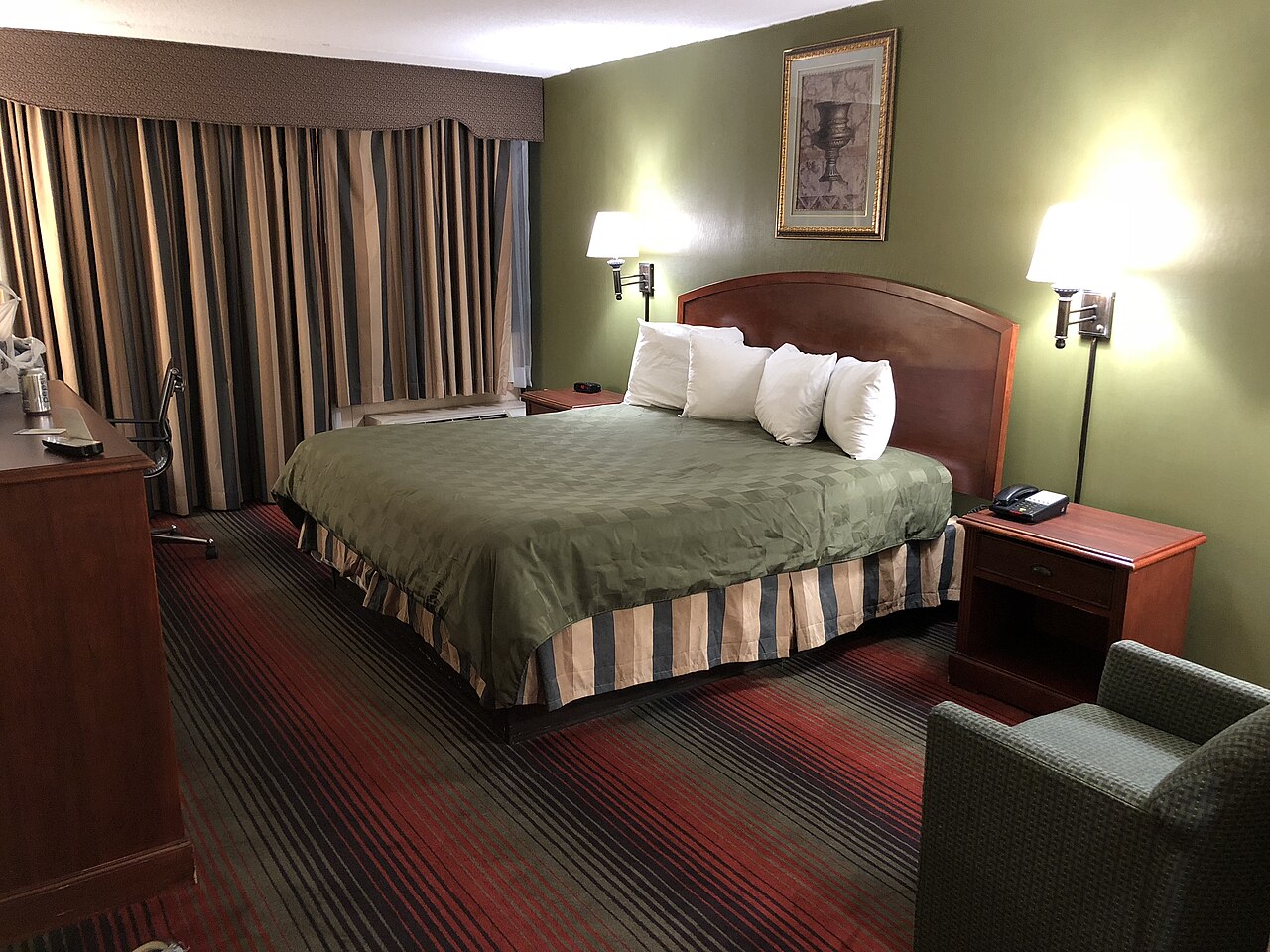
Photo: Wikimedia Commons

Photo: Wikimedia Commons

Photo: Wikimedia Commons

No comments:
Post a Comment