A door that swings needs a full metre of clear floor space — space a small Canadian condo or a narrow hallway simply does not have. A pocket door kit solves that by letting the door glide sideways into the wall cavity, freeing up the swing zone for furniture, storage, or just easier movement.
The kit itself is only part of the job. You need the right rough opening, a wall free of pipes and wires, a door slab the track can carry, and hardware that will still glide smoothly in ten years. These ten tips cover the whole project, with Canadian costs and sizing, so there are no surprises halfway through.
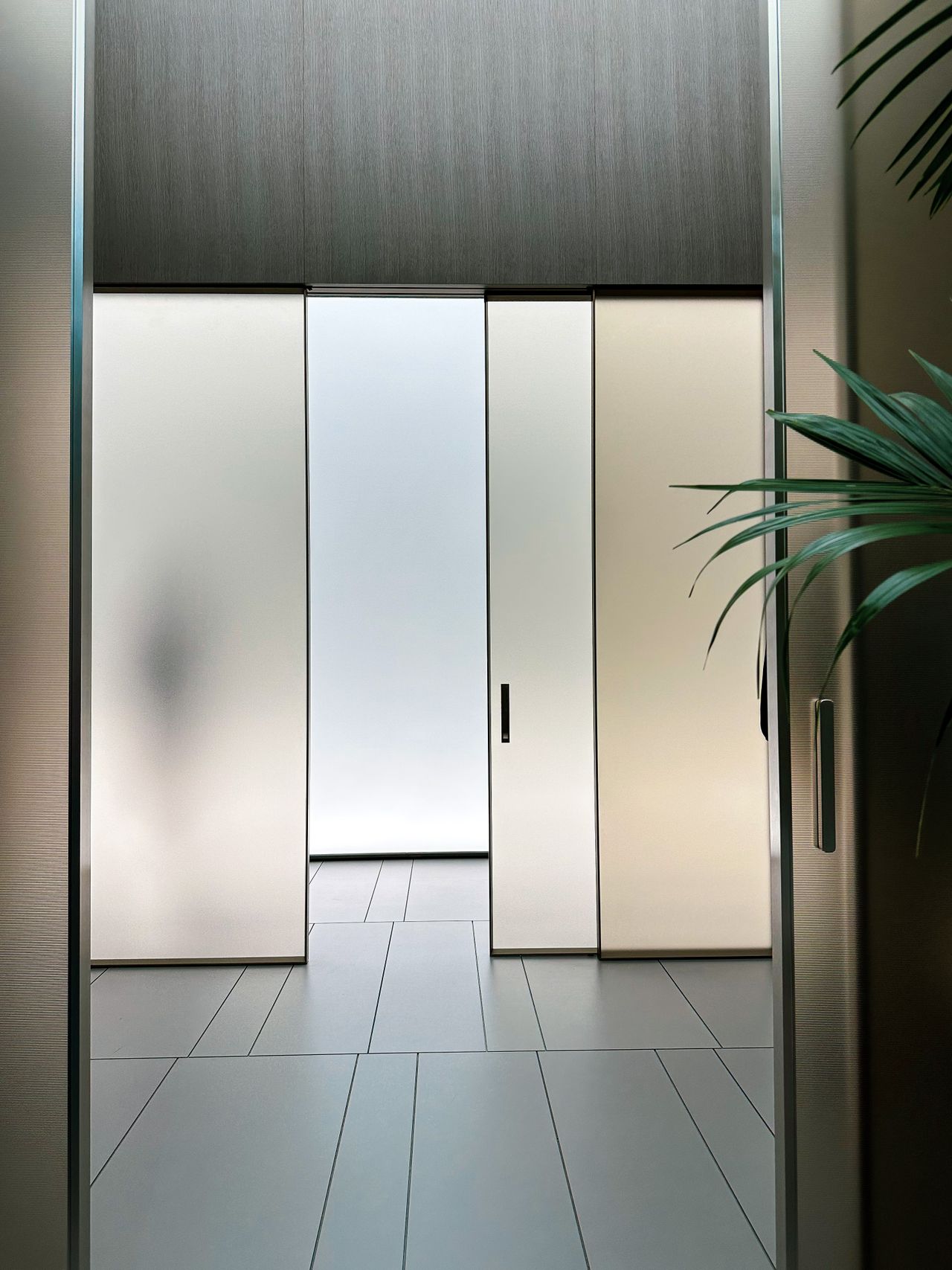
Photo: Pexels
Table of Contents
- 1. Measure the Rough Opening Before You Buy
- 2. Pick a Kit Sized to Your Opening
- 3. Check the Wall for Pipes and Wires First
- 4. Budget the Whole Job, Not Just the Box
- 5. Match the Door Slab to the Track's Weight Rating
- 6. Consider Frosted Glass for Bathrooms
- 7. Choose Recessed Hardware With a Privacy Lock
- 8. Keep the Pocket Clear of Shelves and Outlets
- 9. Install Soft-Close for Quiet Sliding
- 10. Maintain the Track Once a Year
1. Measure the Rough Opening Before You Buy
Every kit is built around a standard door size, and the rough opening in your wall must match. For a single 76 cm (30-inch) door, the framed opening needs to be roughly twice the door width plus about 2.5 cm — around 155 cm wide — and the header height should be the door height plus 5 to 7 cm. Measure the width at the top, middle, and bottom of the opening, and use the smallest number.
Write down three numbers before you shop: the finished floor-to-header height, the stud-to-stud width, and the wall thickness (usually 9 cm for a 2x4 wall with drywall both sides). Bring them to the store or keep them beside you when ordering online — most returns happen because someone guessed the opening size instead of measuring it.
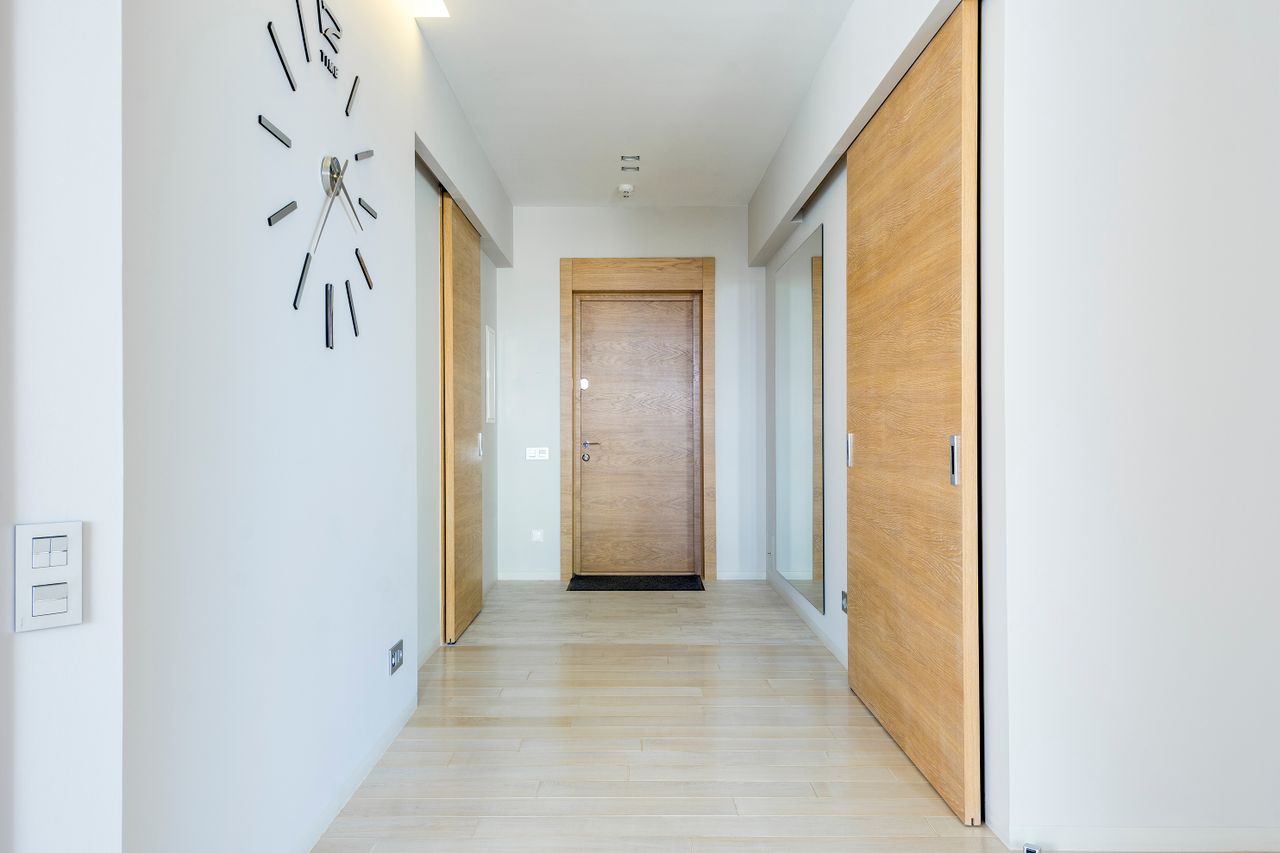
Photo: Pexels
2. Pick a Kit Sized to Your Opening
A pocket door kit is really a split-stud frame with a track: two narrow steel-reinforced studs replace the solid studs on one side of the opening, creating the "pocket" the door slides into. Kits come sized for standard doors — 61, 66, 71, 76, and 91 cm wide — so match the kit to your door slab, not the other way around. A 76 cm door needs the 76 cm kit.
For a double-door opening, buy a converging kit made for two doors that meet in the middle, rather than two single kits pushed together. The converging kit has the right track stops and guides so both doors meet evenly. If your opening is an odd size, size up and trim the door slab down — never try to stretch a small kit to fit a big opening.

Photo: Infrogmation via Wikimedia Commons
3. Check the Wall for Pipes and Wires First
The pocket side of the wall must be hollow — no plumbing, no heating ducts, no electrical cables running through the stud bays where the door will travel. In Canadian homes this is the number-one reason pocket door projects stall: a bathroom wall with a drain stack or a kitchen wall with water lines simply cannot take a pocket without rerouting, which turns a weekend job into a plumber's invoice.
Before you buy anything, cut a small inspection hole in the drywall on the pocket side and look inside with a flashlight, or use a stud finder with deep-scan and AC detection. If you find pipes or wires, pick a different wall — moving a pocket to the opposite side of the opening is free, while moving plumbing costs hundreds. When in doubt, have an electrician check before the drywall comes off.

Photo: S71dart via Wikimedia Commons
4. Budget the Whole Job, Not Just the Box
The kit itself is the cheapest part: expect CAD 120 to CAD 350 at Home Depot or RONA for a quality single-door kit, depending on the size and the weight rating. Then add the door slab (CAD 80 for a basic hollow-core, CAD 250 to CAD 500 for solid-core or glass), trim and paint, and hardware — a recessed pull with a privacy lock runs CAD 40 to CAD 90.
If you hire a carpenter, labour for a new-wall install typically adds CAD 400 to CAD 800, and a retrofit into an existing wall can reach CAD 1,000 or more because of the demolition and drywall repair. All in, budget CAD 600 to CAD 1,000 for a DIY install and CAD 1,200 to CAD 2,000 professionally done. Get the hardware and the door before the carpenter arrives so the job is not held up waiting on parts.

Photo: OCULUS NY via Wikimedia Commons
5. Match the Door Slab to the Track's Weight Rating
Every track has a maximum door weight — commonly 55 kg for standard kits and up to 90 kg or more for heavy-duty ones. A hollow-core door weighs about 11 to 14 kg and glides on any kit, but a solid-core door can weigh 30 to 45 kg, and a solid wood or glass door more. Exceed the rating and the rollers wear out in a year or two instead of lasting decades.
For bathrooms and bedrooms, a solid-core slab is worth the extra money: it blocks far more sound than a hollow door, which matters when the door is the only thing between a toilet and the living room. Just check the kit's rating first and step up to a heavy-duty track if needed — the upgrade usually costs only CAD 40 to CAD 60 more. Weigh the slab on a bathroom scale if the rating is close.

Photo: Infrogmation via Wikimedia Commons
6. Consider Frosted Glass for Bathrooms
A frosted-glass slab is the classic answer for an ensuite or powder room: it lets daylight flow between rooms while keeping the interior private. Most kits accept any slab up to 3.5 cm thick, so a standard glass door fits fine — just confirm the weight, since glass doors run heavier than hollow-core. For more small bathroom layout ideas, pair the door with a wall-hung vanity to keep the floor clear.
Choose true frosted or reeded glass rather than a stick-on film if the budget allows — film peels at the edges in steamy bathrooms within a couple of years. And remember that glass transmits sound almost as easily as a hollow door, so it suits a powder room off the hallway better than the main family bathroom beside the bedrooms.

Photo: Slidoor via Wikimedia Commons
7. Choose Recessed Hardware With a Privacy Lock
A pocket door has no edge to mount a normal knob on, so it needs recessed pulls — flush finger pulls that sit inside the door face. For bathrooms and bedrooms, buy a pull with a built-in privacy lock: a small turn button locks the door, and most have an emergency release slot on the outside you can open with a coin or screwdriver. Budget CAD 40 to CAD 90 for a decent set.
Install the pulls before the door goes on the track, and test the lock with the door both open and closed. Cheap pulls with sharp stamped edges will chew up fingertips over time, so feel the edges in the store — rounded, cast-brass pulls cost a little more and last far longer. Keep the emergency release tool taped inside a nearby cupboard, not in the locked room.

Photo: Cityside189 via Wikimedia Commons
8. Keep the Pocket Clear of Shelves and Outlets
The wall cavity beside the opening belongs to the door forever. No shelves, no recessed medicine cabinets, no electrical outlets or light switches on the pocket side — anything protruding into the cavity will stop the door or get smashed by it. Mark the pocket zone on the floor with tape during the build so nobody mounts anything there by habit.
This catches people most often in bathrooms, where a towel ring or a plug-in outlet seems natural right beside the door. Plan those fittings for the opposite wall or at least 10 cm beyond the pocket's end. The same rule applies after the project is done: never lean furniture, stacks of books, or storage boxes against that stretch of wall.

Photo: Bart Everson via Wikimedia Commons
9. Install Soft-Close for Quiet Sliding
A soft-close damper catches the door in the last few centimetres and eases it shut instead of letting it slam into the jamb. It costs about CAD 25 to CAD 45 per door, fits most standard tracks, and makes the biggest difference in bedrooms and ensuites used at night. If someone in the house is a chronic door-slammer, this is the cheapest peace treaty available.
Add the damper while the wall is still open — retrofitting one later means removing trim to reach the track. Test it with the actual door slab, not an empty track, because the damping is tuned to the door's weight. A door that creeps open on its own after soft-closing usually means the track is not level, not that the damper is faulty.

Photo: Infrogmation via Wikimedia Commons
10. Maintain the Track Once a Year
A pocket door that starts sticking is almost never broken — it is dirty. Once a year, vacuum the floor guide and the visible track with a crevice tool, wipe the rollers with a dry cloth, and spray a silicone-based lubricant (not oil, which attracts dust) on the roller bearings. The whole job takes ten minutes and prevents most service calls.
If the door starts rubbing, check the hanger bolts on top of the door before assuming the track failed — they loosen over years of sliding and a quarter-turn with a wrench often fixes the drag. Persistent jumping off the track usually means a bent track or a worn roller, both replaceable without opening the wall if you bought a kit with removable hangers. For styling once the door glides again, see our entryway decorating ideas.

Photo: Larry McElhiney via Wikimedia Commons
FAQs
How much does a pocket door kit cost in Canada?
The kit alone runs CAD 120 to CAD 350. A complete DIY install with door slab, trim, and hardware lands around CAD 600 to CAD 1,000, while a professional install typically costs CAD 1,200 to CAD 2,000 depending on whether the wall is new or existing.
Can I put a pocket door in an existing wall?
Yes, if the wall is not load-bearing and the pocket side is free of pipes, ducts, and wiring. You open one side of the wall, remove the old studs, install the kit frame, and re-drywall. Load-bearing walls need a proper header and are a job for a carpenter.
What size rough opening does a pocket door need?
For a single door, frame the opening at roughly twice the door width plus 2.5 cm — about 155 cm wide for a standard 76 cm door. The header height should be the door height plus 5 to 7 cm. Always check your specific kit's instructions, as dimensions vary slightly by brand.
Are pocket doors a bad idea for bathrooms?
Not at all, as long as you use a recessed pull with a privacy lock and, ideally, a solid-core slab for sound. Frosted glass is a good option for powder rooms, though it lets more sound through than a solid door.
Can you lock a pocket door?
Yes. Pocket-door locksets are recessed into the door face and include a privacy turn-button for bathrooms and bedrooms, plus an emergency release on the outside. They cost CAD 40 to CAD 90 and install with basic tools.
Final Thoughts
A pocket door is one of the highest-value upgrades for a tight Canadian floor plan — no swing space, a cleaner look, and a door that actually gets used instead of being left open because it blocks the room. The projects that go smoothly all share the same pattern: measured twice, a wall checked for pipes and wires, and a kit matched to the door's weight.
Buy the best track and rollers you can justify, keep the pocket cavity sacred, and give the track ten minutes of maintenance a year. Do that and the door will outlast the paint around it. For more ways to make compact rooms work harder, read our guide to making your living room cosy for winter.
Sources
- This Old House — How to Install an Antique Pocket Door for a Historic Touch
- Family Handyman — How to Repair a Pocket Door
- Johnson Hardware — Pocket Door Hardware Manufacturer
Gallery

Photo: Infrogmation of New Orleans via Wikimedia Commons

Photo: Infrogmation via Wikimedia Commons

Photo: Infrogmation via Wikimedia Commons

No comments:
Post a Comment