Clogged eavestroughs are one of the most common causes of water damage in Canadian homes. When leaves, twigs, and shingle grit block the flow, rainwater spills over the sides and soaks into your fascia, siding, and foundation. Learning how to gutter cleaning the right way protects your home and saves you hundreds of dollars in repairs.
In Canada, most homes need their gutters cleaned twice a year: once in late spring after the seeds and blossoms fall, and once in late autumn after the leaves drop. If you have large maple or oak trees nearby, you may need a third cleaning in midsummer. This guide walks you through the full process with practical tips that work in our climate.

Photo: Wikimedia Commons
Table of Contents
- 1. Know Why Clean Gutters Matter
- 2. Choose the Right Ladder
- 3. Wear Proper Safety Gear
- 4. Scoop Debris by Hand First
- 5. Time It After the Leaves Fall
- 6. Flush With a Garden Hose
- 7. Clear the Downspouts
- 8. Prevent Winter Ice Dams
- 9. Prepare for the Cold Season
- 10. Know When to Call a Pro
1. Know Why Clean Gutters Matter
A blocked gutter does not just look untidy. When water cannot reach the downspout, it overflows and runs down your exterior walls, staining siding and rotting wooden trim. Worse, it pools around your foundation, where freeze-thaw cycles can crack concrete and let water into your basement. In Canada, where a single storm can dump 25 mm of rain, a clogged system fails fast.
Clean gutters also protect your roof. Standing water adds weight — a 3-metre section of full gutter can hold over 40 litres — and in winter that water freezes, forming ice dams that lift shingles. Spending two hours on maintenance each season is far cheaper than a $5,000 roof repair. For more on protecting your home from winter moisture, see our guide on how to draft-proof windows for winter.

Photo: Wikimedia Commons
2. Choose the Right Ladder
Use a sturdy extension ladder, not a stepladder. Your ladder should extend at least 1 metre above the gutter line so you can step on and off safely. Set it on firm, level ground at a 75-degree angle — roughly one metre out from the wall for every four metres of height. Never lean it against the gutter itself; rest it on the wall or use a standoff stabilizer.
Move the ladder every 1.5 to 2 metres instead of overreaching. Overreaching is the top cause of ladder falls. If your home is two storeys or the ground slopes, hire a professional. A pro gutter cleaning costs $150 to $300 CAD for an average Canadian home, which is far less than a hospital visit.

Photo: Wikimedia Commons
3. Wear Proper Safety Gear
Thick work gloves are non-negotiable. Gutters hide sharp metal edges, screws, and sometimes wasp nests or broken glass. Leather or heavy rubber gloves protect your hands while you scoop out soggy debris. Safety glasses keep bits of grit and dried bird droppings out of your eyes when you look up into the trough.
Wear non-slip shoes with good tread, and avoid working in wet or windy conditions. If you use a hose from the ladder, keep one hand on the ladder at all times. A tool belt or bucket hook keeps both hands free while you work, which is much safer than climbing with tools in your pockets.

Photo: Wikimedia Commons
4. Scoop Debris by Hand First
Start at the downspout and work away from it, so you push debris toward the outlet rather than packing it in. Use a plastic gutter scoop or an old garden trowel — metal tools can scratch protective coatings and dent aluminium. Drop the muck into a bucket hung from the ladder, not onto your garden beds below.
Do not compact the debris; lift it out in loose handfuls. Wet, rotted leaves weigh far more than dry ones, so a 20-litre bucket fills quickly. Empty it often to avoid straining your back or tipping the ladder. This hands-on step is the core of how to gutter cleaning properly — no gadget replaces it.

Photo: Wikimedia Commons
5. Time It After the Leaves Fall
In most of Canada, the best autumn cleaning window is late October to mid-November, after the majority of leaves have dropped but before the first hard freeze. Clean too early and a late windstorm refills the troughs; clean too late and you are chipping debris out of ice. Watch your local trees, not the calendar.
Maple, oak, and poplar leaves mat together when wet and form a waterproof layer that is harder to remove than dry leaves. If a big storm is forecast, do a quick pre-clean of the heaviest sections. A leaf blower with a gutter attachment can clear dry leaves fast, but it struggles with the soggy mats — that is hand work.

Photo: Wikimedia Commons
6. Flush With a Garden Hose
Once the big debris is out, flush the trough toward the downspout with a garden hose fitted with a spray nozzle. This washes out the fine silt and shingle grit that scooping misses. Watch the water flow: it should run smoothly to the outlet without pooling. Puddles reveal low spots where the gutter has lost its slope.
Gutters need a gentle slope — about 6 mm of drop per 3 metres — toward the downspout. If water stands in a section, loosen the brackets and adjust, or add a bracket to stop sagging. Brackets should sit roughly every 60 cm; wider spacing lets the trough belly under the weight of water and ice.

Photo: Wikimedia Commons
7. Clear the Downspouts
A clean trough means nothing if the downspout is blocked. Run the hose down from the top; if water backs up, the clog is below. Try a plumber's snake or a blast from the bottom up with the hose. Never use a pressure washer inside a downspout — it can split the seams and blow the elbows apart.
Check where the downspout discharges. It should carry water at least 1.8 metres from your foundation, ideally into a splash block or buried drain tile. Downspouts that dump beside the basement wall are a leading cause of damp basements in Canada. Extenders cost under $20 CAD at any hardware store and take minutes to fit.
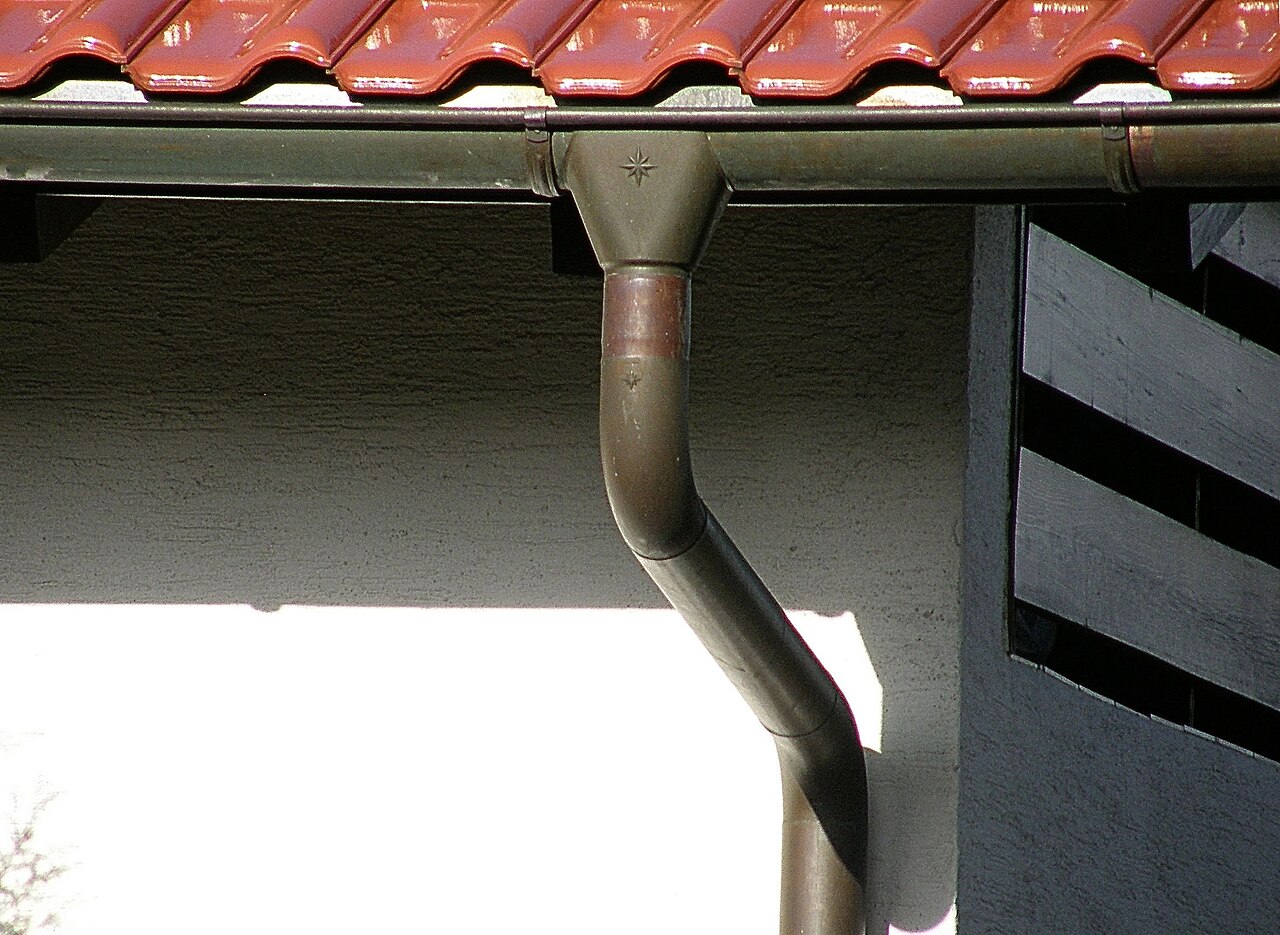
Photo: Wikimedia Commons
8. Prevent Winter Ice Dams
Ice dams form when heat escaping through the roof melts snow, which refreezes at the colder eaves. Clogged gutters make it worse by trapping meltwater. Before winter, make sure troughs are empty and downspouts flow freely. In the attic, check that insulation is even and soffit vents are not blocked — a cold roof deck is your best defence.
Heated gutter cables ($60 to $120 CAD for a 30-metre kit) can keep a channel open through freeze-thaw cycles on problem sections. Do not chip at ice with an axe or shovel; you will dent the gutter and void its warranty. A roof rake used from the ground pulls snow off the lower 2 metres, which is where dams start.

Photo: Wikimedia Commons
9. Prepare for the Cold Season
Canadian winters are brutal on gutters. After your autumn cleaning, do a final inspection in late November. Look for loose brackets, sagging sections, and any place where water might pool and freeze. Tighten what you can from the ladder, and mark problem spots for spring repair.
If you use a rain barrel, disconnect and drain it before the first freeze, or ice will split it. Store it upside down in the garage. Come spring, reconnect it after your spring gutter cleaning. These small habits prevent the freeze-thaw damage that shortens gutter life.

Photo: Wikimedia Commons
10. Know When to Call a Pro
DIY is fine for single-storey homes with easy ladder access. Call a professional if your home is two storeys or higher, the ground slopes steeply, gutters are pulling away from the fascia, or you spot rust holes and split seams. Pros also handle guard installation, which involves working along the entire roofline.
Get two or three quotes and ask whether the price includes downspout flushing and a basic inspection. In Canada, expect $150 to $300 CAD for a typical bungalow and $250 to $450 for a two-storey. Anyone quoting far below that may be skipping the downspouts — ask exactly what is included before you book.

Photo: Wikimedia Commons
FAQs
How often should I clean my gutters in Canada?
Twice a year at minimum — late spring and late autumn. Homes under heavy tree cover may need a third cleaning in midsummer.
Can I clean gutters from the ground?
Telescoping wands and gutter vacuums work for light debris on bungalows, but they cannot match a hands-on cleaning for packed, wet leaves.
Are gutter guards worth it?
Mesh guards cut cleaning frequency but do not eliminate it. Fine seeds and shingle grit still get through, so plan an inspection every year.
What does professional gutter cleaning cost in Canada?
Expect $150 to $300 CAD for a bungalow and $250 to $450 for a two-storey home, including downspout flushing.
When should I clean gutters before winter?
Aim for late October to mid-November, after most leaves have fallen but before sustained freezing temperatures arrive.
Final Thoughts
Gutter cleaning is unglamorous work, but it is one of the highest-value chores a homeowner can do. Two afternoons a year protect your roof, walls, and foundation from water damage that costs thousands to fix. Work safely, scoop first and flush second, and keep those downspouts flowing away from the house.
If you found this guide useful, you may also enjoy our covered patio ideas for making the most of your outdoor space once the maintenance is done.
Sources
Gallery

Photo: Wikimedia Commons

Photo: Wikimedia Commons

Photo: Wikimedia Commons

No comments:
Post a Comment