A blank diary can feel like a dare. You want to write in it, but the empty pages look too perfect to touch. Decorating your diary solves that problem. A few colors, a little texture, and a theme you love turn a plain notebook into something you reach for every day. This guide shows you how to do it simply, cheaply, and in a way that still leaves room for your words.

Open handwritten journals with a pen and dried flowers. Photo by Polina via Pexels.
Why Decorating Your Diary Is Worth It
A decorated diary does more than look nice. It gives you a small ritual. Opening a page that already feels like yours makes it easier to sit down and write, even on tired days. People who keep journals often say the same thing: the prettier the page, the more honest the writing. You do not need artistic talent for any of this. You need a few supplies, a little patience, and permission to make the first pages messy.
Start With the Cover
The cover is what you see first, so it sets the mood for everything inside. Before you touch the pages, decide on a simple color palette of two or three shades. A limited palette keeps the whole diary looking calm and intentional instead of chaotic.
For a soft, cozy feel, wrap the cover in fabric. Cut a piece of cotton, velvet, or canvas slightly larger than the cover, fold the edges over like wrapping a gift, and glue them down inside the front and back boards. A thin layer of craft glue or double-sided tape holds it well, and the texture makes the diary feel personal the moment you pick it up.
If you prefer a bolder look, make a collage. Cut shapes, words, and pictures from old magazines, wrapping paper, or printed photos, and arrange them on the cover until you like the layout. Glue each piece down, then brush a thin coat of decoupage sealer (like Mod Podge) over the whole thing. It dries clear and protects the collage from peeling and fingerprints.
The simplest option works too: a plain cover with a few good stickers. Vinyl stickers are the easiest to reposition, so you can change the design whenever your taste changes. Whatever you choose, keep the spine flexible so the diary still opens flat.
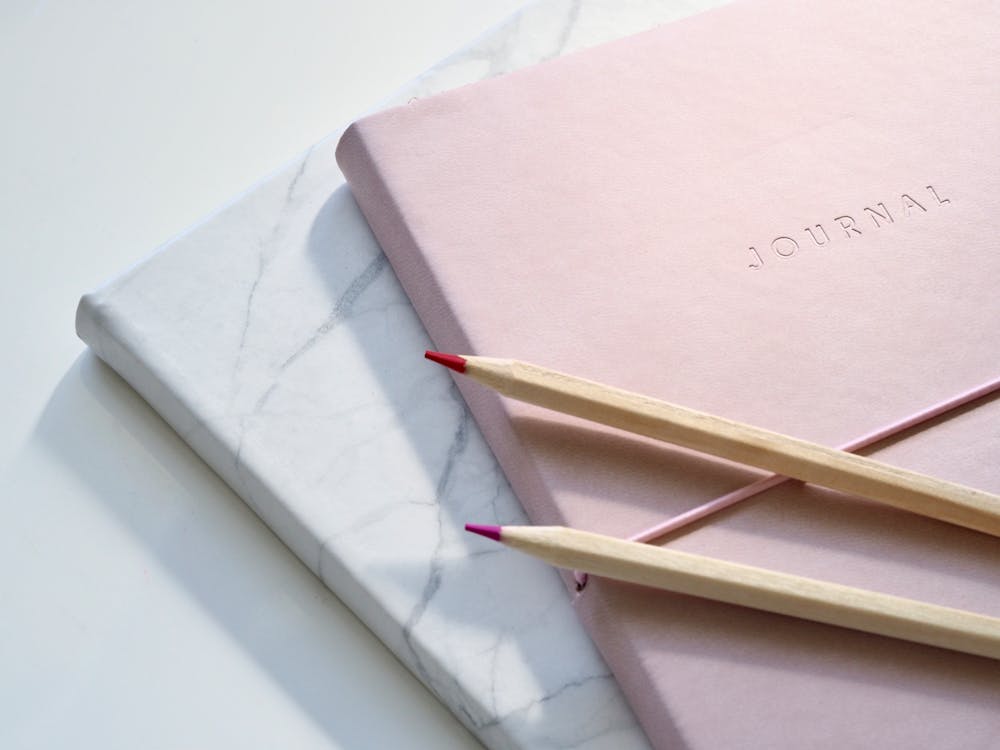
A simple embossed journal cover with colored pencils. Photo by Jess Bailey Designs via Pexels.
Build a Small, Budget-Friendly Supply Kit
You do not need a craft store haul to decorate a diary. A small kit of versatile basics will carry you through the whole book:
- Washi tape. The single most useful item. This decorative paper tape from Japan sticks, peels off cleanly, and tears by hand. Use it for page borders, photo corners, tabs, and quick stripes of color. A few rolls in your palette colors are enough.
- Scrap paper. Kraft paper, old book pages, paper doilies, envelopes, and ticket stubs all become layering material. Torn edges look better than cut ones, so you do not even need scissors.
- Pens that do not bleed. Fineliners and smooth gel pens keep your writing crisp without ruining the back of the page. Test every new pen on the last page of the diary first.
- Clean adhesives. Glue tape rollers and glue sticks are tidier than liquid glue and will not warp thin pages.
- Small scissors or a craft knife. For cutting out magazine images and trimming paper to size.
Most of this costs very little, and much of it you may already own. The rule is simple: buy one good pen and a few rolls of washi tape before anything else. Everything after that is a bonus.

A small kit of pastel pens, highlighters, sticky notes and paper clips. Photo by Katrin Bolovtsova via Pexels.
A Simple 4-Step Way to Lay Out Any Page
A blank page is less scary when you build it in layers. Try this order every time, and even your first pages will look put-together.
Step 1: Set the frame. Run a strip of washi tape along the top or bottom of the page, or draw a loose border with a fineliner. This defines where your entry lives and instantly makes the page feel designed.
Step 2: Add background texture. Glue small torn pieces of kraft paper, grid paper, or an old book page into the corners. Keep them flat and thin so the page still closes properly.
Step 3: Write your entry. Do the actual writing in the open center space with a smooth black or dark pen. Write first, decorate around it — never the other way round.
Step 4: Fill the gaps. Once the writing is done, add small stickers, tiny doodles, or a date stamp in the leftover spaces. A page looks finished when every corner has a little intention in it.
Give special care to the very first page. It sets the theme for the whole book, so many people make it a title page: the diary's name, the year, a favorite quote, and a small collage. After that, every page follows the same four steps.

A hand-drawn weekly spread with little day banners on grid paper. Photo by Bich Tran via Pexels.
Pick a Theme That Feels Like You
A theme is what turns random decorations into a diary that feels like one continuous story. Pick one direction and let it guide your colors, stickers, and lettering.
Dark academia. Sepia tones, fountain-pen ink, wax seals, dried flowers, and old book pages. Moody and literary, perfect if your diary holds long reflective entries. Black or deep brown ink on cream paper is the whole look.
Botanical minimal. Lots of white space, pressed leaves and flowers, soft sage green accents, and one clean handwriting style. Calm and uncluttered — the decorations frame your words instead of competing with them.
Y2K scrapbook. Holographic stickers, bright pinks, ticket stubs, polaroid-style photos, and chunky doodles. Loud and joyful, great for diaries that capture fun memories and friendships.
Vintage travel. Maps, postage stamps, kraft paper pockets for keepsakes, and leather or canvas textures. Works beautifully if your diary doubles as a travel log.
You can also change themes by section — one color palette per month keeps the diary fresh without losing cohesion. Whatever you choose, repeat two or three signature elements (the same washi tape, the same header style) so the book still feels like one diary, not twelve.

Hand lettering with a fountain pen and inkwell. Photo by Polina Kovaleva via Pexels.
Keep It Writable: The One Rule That Matters
Here is the rule experienced journal keepers repeat most: never decorate so much that you run out of room to write. A diary is first a place for your thoughts; the decoration is the frame, not the picture. Leave generous open space on every page, keep layered paper thin so the book still closes, and skip bulky 3D embellishments that stop pages lying flat. If a page ends up too busy, the next one is a fresh start — that is the beauty of a diary.
Diary Decoration Inspiration
A few real setups to spark ideas for your own pages:
 A leather travel journal with a wrap closure. Photo by Yashasvi Nagda via Pexels. |
 Slow, steady handwriting on the page. Photo by Tima Miroshnichenko via Pexels. |
 A pastel desk setup with tabbed notebook. Photo by Kaboompics.com via Pexels. |
 A single flower on an open page — simple botanical styling. Photo by Marta Nogueira via Pexels. |
Final Thoughts
Decorating your diary is really about making writing feel inviting. Start with the cover, gather a handful of cheap supplies, build each page in four simple layers, and pick a theme that feels like you. There is no right or wrong way to do it — the best-decorated diary is simply the one you keep opening. Pick up your favorite pen, tear off a strip of washi tape, and make the next page yours.
Frequently Asked Questions
What can I use to decorate my diary if I do not have fancy stickers?
You can use everyday household items like torn magazine pages, old ticket stubs, dried leaves, or simply draw tiny doodles with colored pens. Scraps of wrapping paper and printed photos also work wonderfully for adding texture.
How do I stop my markers from bleeding through the diary pages?
Always test your pens on the very back page of your notebook first. To prevent bleeding, use fineliners or standard ballpoint pens instead of heavy permanent markers, or upgrade to a diary with thicker paper (at least 100gsm).
How can I make my natural handwriting look better in my journal?
Practice writing slowly and maintaining a consistent slant across the page. You can also mix cursive headers with neat, printed text for the main paragraphs to make the pages look much more stylized and intentional.

No comments:
Post a Comment