Table of Contents
- First: The Planning Rules (Read Before You Decorate)
- 1. Bold Wallpaper Statement
- 2. Dark Jewel-Box Paint
- 3. Oversized Round Mirror
- 4. Floating Vanity
- 5. Pedestal Sink for Tight Spaces
- 6. Statement Pendant Light
- 7. Sconces Flanking the Mirror
- 8. Patterned Floor Tile
- 9. Wainscoting
- 10. Brass Fixtures Upgrade
- 11. Over-Toilet Open Shelving
- 12. Framed Artwork
- 13. Warm Wood Vanity
- 14. A Live Plant
- 15. Renter-Friendly Refresh
- Real Budget Guide: Three Tiers
- Small-Space Tricks That Actually Work
- Final Thoughts
- FAQs
- Gallery: More Half Bathroom Inspiration
- Sources
A half bathroom — also called a powder room — is a small bathroom with just a toilet and a sink. No shower. No bathtub. Most are only 20 to 30 square feet, tucked under stairs, off a hallway, or near the front door for guests.
Because it is tiny, most people ignore it. They paint it beige and forget it. That is a mistake. Your powder room is the one room every guest will visit. It is also the one room where you can be bold without risk — a wild wallpaper or a dark paint colour only covers a few walls, costs little, and takes a weekend.
After 15 years of designing bathrooms, I can tell you this: the powder room is the easiest room in your home to transform. This guide to half bathroom design ideas gives you 15 practical looks, the exact measurements that matter, real budgets, and answers to the questions people actually ask. Every idea below includes how to do it, what it costs, and what to avoid.

Photo: HAUS By Emily May, CC BY 2.0, via Flickr
First: The Planning Rules (Read Before You Decorate)
Before you buy a single thing, learn the numbers. They save you from expensive mistakes.
Minimum size: a working half bath needs about 20 square feet of floor space. The National Kitchen and Bath Association (NKBA) sets the key clearances: at least 15 inches from the centre of the toilet to any side wall, and at least 21 inches of clear open space in front of the toilet. Measure these before you shop. A vanity that looked perfect in the showroom can block the door in your real room.
Vanity size: for most powder rooms, choose a vanity 24 to 36 inches wide and 16 to 20 inches deep. In very tight rooms, go narrower. Tape the footprint on your floor with painter's tape and walk around it. If you bump into it, it is too big.
Door swing: the most common powder room problem is a door that hits the vanity or the toilet. Three fixes work: a pocket door that slides into the wall, a barn door that slides along the outside wall, or reversing the door so it swings out into the hallway instead of into the room. Check clearances first — the cheapest fixture is the one you do not have to return.
Ventilation: building codes (the International Residential Code, or IRC) require mechanical ventilation — an exhaust fan — in any bathroom without an openable window. This matters for wallpaper too. A fan that actually runs keeps humidity low and your walls safe.
1. Bold Wallpaper Statement

Photo: Dracolique, CC BY-SA 4.0, via Wikimedia Commons
Wallpaper is the number one powder room move for a reason. A half bath has no shower steam, so wallpaper is safer here than in any other bathroom. One bold pattern turns a boring box into a room guests photograph.
What to buy: choose a washable vinyl wallpaper or a peel-and-stick paper. Vinyl resists moisture and wipes clean. Peel-and-stick costs $30 to $60 per roll and removes without damage — perfect if you rent. Measure your walls: a typical powder room needs 4 to 6 rolls. Buy one extra roll for pattern matching.
How to do it: start on the wall behind the toilet or vanity — the wall people see first. Match the pattern at the seams carefully; mismatched patterns look cheap. If you are new to hanging paper, hire the job out — labour runs $200 to $400 for a small room, and a bad DIY paper job is very visible.
What to avoid: cheap paper that is not washable will peel within a year. And always run your exhaust fan. Even without a shower, humidity from hot water at the sink adds up. Bold wallpaper also works beautifully in children's bathrooms — these girls bathroom ideas show age-smart ways to use pattern for every stage from toddler to teen.
2. Dark Jewel-Box Paint

Photo: jjeahall, CC BY 2.0, via Flickr
Dark paint in a tiny room sounds wrong. It is not. Designers call this the jewel-box effect: a small room painted deep navy, forest green, or charcoal feels intentional and dramatic, not cramped. Guests remember it. Light beige, they forget.
What to buy: one gallon of paint covers a powder room easily — budget $40 to $70 for quality paint. Use a satin or eggshell finish. It wipes clean, resists moisture, and bounces light gently around the room. Avoid flat paint (it stains and absorbs light) and high-gloss (it shows every wall bump and glares in tight spaces).
How to do it: paint all four walls and the ceiling the same dark colour — this is called colour drenching, and it actually makes low ceilings feel taller because the eye sees no harsh lines. Balance the darkness with warm light (2700K bulbs) and one large mirror to bounce light back.
What to avoid: do not use dark paint with cool white bulbs — the room will feel like a cave. Warm light is non-negotiable. For a complete guide to working with monochrome drama, see these black and white bathroom decor ideas — the same contrast principles apply.
3. Oversized Round Mirror

Photo: PattayaPatrol, CC BY-SA 4.0, via Wikimedia Commons
A large mirror is the cheapest way to double a small room. It bounces light, reflects the prettiest wall, and makes 25 square feet feel like 50. If you buy one thing for your powder room, make it the mirror.
What to buy: choose a mirror as wide as your vanity — or wider for drama. Round and arched mirrors soften the hard boxy lines of a small room. Budget $60 to $200 for a good round mirror. Look for a thin frame (brass, black, or wood) rather than a heavy one.
How to do it: hang the centre of the mirror at about 60 to 65 inches from the floor — roughly eye level. If your vanity is narrow, let the mirror overhang slightly on each side; this trick makes the vanity look bigger than it is. Secure heavy mirrors into a wall stud, not just drywall.
What to avoid: a tiny mirror in a small room is a missed opportunity. And skip mirrors with built-in harsh LED rings — the cool light is unflattering. Warm sconces beside the mirror (see idea 7) give far better light for faces.
4. Floating Vanity

Photo: Jeremy Levine Design, CC BY 2.0, via Flickr
A floating vanity hangs on the wall with open space below it. Your eye sees floor continuing underneath, so the room feels bigger. It also makes mopping easy — no legs to clean around. In a powder room, this single change can transform how spacious the room feels.
What to buy: wall-mounted vanities run $150 to $500. For a powder room, 24 inches wide is the sweet spot. Check that your wall can hold the weight — you need solid blocking or studs behind the mounting points, not just drywall. If your wall is weak, a contractor can add blocking for about $100.
How to do it: mount the vanity so the top sits 32 to 34 inches from the floor — standard comfortable height. Leave at least 8 inches of open space below for the floating effect. Pair it with a wall-mounted faucet to keep the small top clutter-free.
What to avoid: do not mount a floating vanity on a wall you are unsure about. A vanity full of water and toiletries is heavy. And skip deep vanities here — 16 to 18 inches deep is plenty for a powder room sink.
5. Pedestal Sink for Tight Spaces

Photo: Downtowngal, CC BY-SA 3.0, via Wikimedia Commons
When the room is truly tiny — under 25 square feet — a pedestal sink is often the answer. It takes up almost no visual space. The floor stays open, the room breathes, and the sink itself becomes a sculptural object. Vintage pedestal sinks, like the pink 1920s one above, add character no modern box can match.
What to buy: new pedestal sinks cost $100 to $300. Salvage shops often have beautiful vintage ones for less. Measure your rough-in (the distance from the wall to the drain pipe) before buying — most are 8 inches, and the sink must match.
How to do it: pedestal sinks give you zero storage, so plan for it. Add a small wall cabinet, a recessed medicine cabinet, or a basket under a wall shelf for spare toilet paper. Mount a towel ring on the nearest wall — within arm's reach of the sink, not across the room.
What to avoid: do not choose a pedestal if you need hidden storage for cleaning supplies and spare towels. In that case, a small vanity (idea 4) serves you better. The rule is simple: pedestal for airiness, vanity for storage.
6. Statement Pendant Light

Photo: Warren LeMay, CC0, via Wikimedia Commons
Most powder rooms get a boring flush-mount ceiling light. Swap it for a small pendant and the whole room gets a jewellery moment. A pendant draws the eye up, adds personality, and costs far less than people expect.
What to buy: small pendants run $50 to $150. Choose one scaled to the room — 8 to 12 inches in diameter is right for a powder room. Anything bigger overwhelms. Hang it so the bottom sits at least 7 feet above the floor, clear of heads and the door swing.
How to do it: centre the pendant over the room or above the toilet area, not directly over the sink (that is what sconces are for — see idea 7). Use a warm LED bulb, 2700K to 3000K. The Illuminating Engineering Society (IESNA) recommends this warm range for bathrooms — it flatters skin and feels welcoming.
What to avoid: one light source is never enough in a windowless room. A pendant gives style, but pair it with mirror lighting so faces are lit well. And check the ceiling height — in rooms under 8 feet, choose a semi-flush pendant that hugs the ceiling.
7. Sconces Flanking the Mirror

Photo: Paul Schultz, CC BY 2.0, via Wikimedia Commons
Overhead light alone casts shadows down your face — unflattering and harsh. Two small sconces, one on each side of the mirror, put soft even light on your face. This is the lighting setup designers use in every good bathroom, and it matters most in a small one.
What to buy: a pair of sconces costs $60 to $200. Choose shades that throw light outward and slightly down, not bare bulbs (bare bulbs glare in tight rooms). Make sure the style matches your faucet finish — mixed metals look messy in a 25-square-foot room.
How to do it: mount sconces so the centre of each shade sits 60 to 65 inches from the floor — about eye level. Place them 28 to 30 inches apart, flanking the mirror. If wall space is too tight for two, one sconce on each side of a narrow mirror still beats a single overhead light.
What to avoid: do not skip the electrician if you have no existing wiring — adding sconces where none existed costs $150 to $300 per fixture for an electrician. Worth it, but budget for it. And always use warm bulbs; cool white in a small bathroom feels like an office.
8. Patterned Floor Tile

Photo: w_lemay, CC BY-SA 2.0, via Wikimedia Commons
The floor is the biggest uninterrupted surface in a powder room. A patterned tile — encaustic-look, mosaic, or geometric — turns that surface into art. Because the room is small, you need very few tiles, so you can afford a pattern that would be too expensive in a large bathroom.
What to buy: patterned porcelain tiles run $5 to $15 per square foot. A powder room floor is often under 25 square feet, so the tile itself may cost under $300. Choose porcelain over real encaustic cement — porcelain looks the same, needs no sealing, and resists stains.
How to do it: keep the walls simple when the floor is busy. White or soft neutral walls let the floor be the star. Use a small grout line (3mm) in a colour close to the tile so the pattern reads clearly. Run the same tile under the vanity and toilet — cutting around fixtures looks choppy.
What to avoid: two bold patterns in one tiny room fight each other. If the floor is patterned, the walls stay calm. And check slip resistance — look for tiles rated for bathroom floors so the pretty pattern is also safe.
9. Wainscoting

Photo: Famartin, CC BY-SA 4.0, via Wikimedia Commons
Wainscoting — wood panelling on the lower half of the wall — adds instant architecture to a plain box. It makes a builder-grade powder room feel custom and finished. Beadboard is the classic choice, but simple board-and-batten works in modern homes too.
What to buy: beadboard panels cost $20 to $40 per 4x8 sheet, or use individual trim boards for a board-and-batten look at about $1 to $2 per linear foot. A powder room needs very little material — most projects cost under $150. Use moisture-resistant MDF or PVC boards, not raw wood, in a bathroom.
How to do it: run the panelling 32 to 36 inches high — about chair-rail height. Paint it white or soft cream, then paint or wallpaper the wall above. Caulk every seam where the panelling meets the wall and floor; caulk is what keeps bathroom woodwork alive.
What to avoid: do not run wainscoting behind the toilet tank without leaving access. If the tank ever needs repair, you will be glad you can reach it. And never use unsealed wood — bathroom humidity will warp it within a year.
10. Brass Fixtures Upgrade

Photo: PattayaPatrol, CC BY-SA 4.0, via Wikimedia Commons
Swapping a basic chrome faucet for brass is the highest-impact small upgrade in a powder room. Guests touch the faucet. They notice it. Warm brass against white porcelain reads as luxury — and it takes an afternoon, not a renovation.
What to buy: a good brass faucet costs $80 to $250. Match the finish across the faucet, towel ring, toilet-paper holder, and mirror frame — one metal, used everywhere, looks intentional. Brushed brass hides water spots better than polished brass. Budget another $60 to $120 for the matching accessories.
How to do it: shut off the water valves under the sink first — always. Most faucets swap in under an hour with a basin wrench. Replace the supply lines at the same time if they are old; new braided lines cost $10 and prevent leaks. Wrap thread tape on every connection.
What to avoid: mixing metals (chrome faucet, brass mirror, black towel bar) looks accidental in a tiny room. Pick one and commit. And in hard-water areas, wipe brass weekly with a soft cloth — mineral spots show more on warm finishes.
11. Over-Toilet Open Shelving

Photo: Sarah Stierch, CC BY 4.0, via Wikimedia Commons
The wall above the toilet is dead space in most powder rooms. Two or three open shelves turn it into storage and display. Folded white towels, a small basket, a candle — suddenly the room feels styled instead of empty.
What to buy: floating wood shelves cost $25 to $60 each. Choose shelves 8 to 10 inches deep — deep enough for folded towels, shallow enough to stay out of head-bump range. Solid wood or thick MDF holds weight without sagging.
How to do it: mount the lowest shelf at least 24 inches above the toilet tank lid so you can lift the lid fully. Anchor every shelf into studs. Style with the rule of three: towels (useful), a basket (hides clutter), one decorative object (a small plant or candle). Roll hand towels instead of folding — they look fuller on display.
What to avoid: open shelves collect dust, so do not display anything you will not wipe monthly. And never mount shelves where a tall guest will hit their head standing up — measure twice.
12. Framed Artwork

Photo: Sarah Stierch, CC BY 4.0, via Wikimedia Commons
Art in a bathroom surprises people — which is exactly why it works. A powder room is small enough that one framed print becomes a focal point. It tells guests this room was designed, not left over.
What to buy: any print you love, in a frame with glass. Glass is the key — it protects the art from humidity. Budget $30 to $100 for a framed piece. Black-and-white photography is a safe, elegant choice that suits almost any colour scheme.
How to do it: hang art on the wall guests face while seated — usually above the toilet or on the side wall. Keep it away from direct splash zones near the sink. Use proper picture hooks rated for the frame's weight, and hang the centre at about 57 inches from the floor, gallery height.
What to avoid: unframed canvas or paper prints will absorb moisture and warp. If you love a piece too much to risk it, hang a high-quality print of it and keep the original elsewhere. And skip oversized art — one medium piece beats a crowded gallery wall in 25 square feet.
13. Warm Wood Vanity

Photo: PickComfort, CC BY 2.0, via Flickr
White bathrooms can feel cold. A warm wood vanity — walnut, oak, or teak — fixes that instantly. Wood adds the organic warmth that tile and porcelain lack. In a small room, one wooden element is enough to change the entire feeling.
What to buy: wood vanities run $200 to $600 for powder-room sizes. Look for a sealed finish rated for bathrooms — raw wood and water are enemies. A floating wood vanity combines this idea with idea 4 for double the space-saving effect.
How to do it: let the wood be the warm accent against white walls and a white sink. Keep the countertop simple — white quartz or porcelain lets the wood grain shine. If a new vanity is too much, paint your existing vanity in a wood-look finish or add a wood-framed mirror for a smaller dose of warmth.
What to avoid: real wood needs its sealer maintained — re-oil or re-seal every year or two in a bathroom. And do not pair wood with too many other warm tones; one wood element plus brass is plenty. More than that and the small room feels busy.
14. A Live Plant

Photo: The Urban Botanist Images, CC BY 2.0, via Wikimedia Commons
One plant changes a bathroom more than almost any accessory. Green softens hard tile edges, adds life, and makes the room feel cared for. Bathrooms are actually good homes for many plants — the humidity from hand-washing helps tropical varieties.
What to buy: choose low-light, humidity-loving plants. Pothos, snake plants, and ferns thrive in bathrooms. A small potted plant costs $10 to $25. If your powder room has no window at all, pick a high-quality faux plant instead — a good faux plant beats a dead real one.
How to do it: place the plant on a shelf, the back of the toilet, or a corner stool — anywhere it will not get knocked by elbows in the tight space. A trailing pothos on a high shelf is ideal: it needs no floor space and softens the room's hard lines. Water sparingly; bathroom humidity does half the work.
What to avoid: do not crowd a tiny room with five plants. One healthy plant is styling; five is a jungle that blocks movement. And skip plants with sharp leaves at elbow height in narrow rooms.
15. Renter-Friendly Refresh

Photo: Smtzzz, CC BY-SA 4.0, via Wikimedia Commons
Renters deserve a beautiful powder room too. Everything in this idea removes without damage: peel-and-stick wallpaper, a new mirror hung on the existing hook, colourful towels, a new toilet seat, and swapped cabinet hardware (keep the originals in a bag to reinstall later).
What to buy: peel-and-stick wallpaper ($30 to $60 per roll), a statement mirror ($60 to $150), new towels ($30), a soft-close toilet seat ($25 to $40), and replacement knobs or pulls ($3 to $8 each). Total refresh: $150 to $300, and your deposit stays safe.
How to do it: start with the wallpaper — it covers the most wall for the money. Then the mirror, then textiles. These three changes alone transform the room. Photograph everything before you change it so you can restore the original condition on moving day.
What to avoid: never paint without written landlord permission — it is the number one deposit killer. And test peel-and-stick paper on a hidden spot first; on some paints it can pull the finish when removed. Heat it gently with a hairdryer during removal to protect the wall.
Real Budget Guide: Three Tiers
You do not need a big budget. Here is what each spending level actually buys in a powder room.
Refresh — under $300: paint ($50), a new mirror ($80), new towels and accessories ($60), a peel-and-stick wallpaper accent wall ($60), and swapped hardware ($40). This tier changes how the room feels without touching plumbing or tile. Best value per dollar in home design.
Mid-range — $800 to $1,500: everything in the refresh tier, plus a new faucet and accessories in a matching finish ($250), a pair of sconces with electrician ($400), two floating shelves ($80), and framed art ($80). The room now looks professionally designed.
Full renovation — $3,000 and up: new floor tile ($600 to $1,000 installed), a new vanity and top ($500 to $900), new toilet ($250 to $400), lighting, mirror, and paint. You are rebuilding the room, so plan the layout with the NKBA clearances from the planning section first.
One more number worth knowing: the National Association of Home Builders (NAHB) reports that adding a half bath can raise a home's value by roughly 10 percent. A main-floor powder room for guests is one of the highest-return small projects in a home.
Small-Space Tricks That Actually Work
Beyond the 15 ideas, these are the professional tricks I use in every tiny bathroom.
Keep the floor visible. The more floor you see, the bigger the room feels. That is why floating vanities and pedestal sinks work — they show floor. Avoid bulky cabinets that sit on the ground.
Run one flooring material straight through. If the powder room opens off a hallway, using the same flooring in both spaces erases the visual boundary. The eye reads one larger space instead of two small ones.
Use vertical lines. Vertical wallpaper stripes, tall narrow mirrors, and floor-to-ceiling tile draw the eye up and make low ceilings feel taller. Horizontal lines do the opposite — avoid wide horizontal tile bands in low rooms.
Light it like a jewel box, not a closet. One overhead bulb is never enough. Combine ambient light (pendant or ceiling) with face light (sconces) in warm 2700K to 3000K. Good lighting makes 25 square feet feel generous; bad lighting makes 50 feel cramped.
Limit the palette. Two to three colours maximum. Every new colour chops the small room into smaller visual pieces. Pick a palette and repeat it in the wallpaper, towels, and art.
Final Thoughts
Your powder room is small, but it works hard. It greets your guests, serves your family daily, and — as the NAHB numbers show — adds real value to your home. It deserves better than beige.
Start with the planning rules: measure your clearances, fix the door swing, and make sure the fan runs. Then pick one big move — wallpaper, dark paint, or a patterned floor — and support it with good lighting and one great mirror. That formula alone beats most professionally designed powder rooms.
These half bathroom design ideas prove that a tiny room can carry the boldest choices in your home. Pick the one that excites you, do it well, and enjoy the room your guests will talk about.
FAQs
What is the minimum size for a half bathroom?
About 20 square feet of floor space. The NKBA requires 15 inches from the toilet centre to any side wall and 21 inches of clear space in front of the toilet.
Can I put wallpaper in a half bath with no window?
Yes — it is the safest bathroom for wallpaper since there is no shower steam. Use washable vinyl or peel-and-stick paper, and run your exhaust fan.
Pedestal sink or small vanity — which is better?
Pedestal for the smallest rooms where airiness matters most; a compact 24-inch vanity when you need hidden storage for towels and supplies.
What paint finish works best in a powder room?
Satin or eggshell. It wipes clean, resists moisture, and bounces light. Avoid flat paint (stains) and high-gloss (shows every flaw).
How do I make a tiny powder room feel bigger?
One large mirror, visible floor (floating vanity or pedestal), warm layered lighting at 2700K-3000K, and a limited two-to-three colour palette.
What does a powder room refresh cost?
A cosmetic refresh runs $150 to $300 (paint, mirror, towels, hardware). A mid-range update with lighting and faucet runs $800 to $1,500.
Does adding a half bath increase home value?
Yes. The National Association of Home Builders reports roughly a 10 percent value increase — one of the best returns of any small home project.
Do I need an exhaust fan if there is no shower?
Yes. Building codes require mechanical ventilation in any bathroom without an openable window, and it protects your paint and wallpaper.
Gallery: More Half Bathroom Inspiration
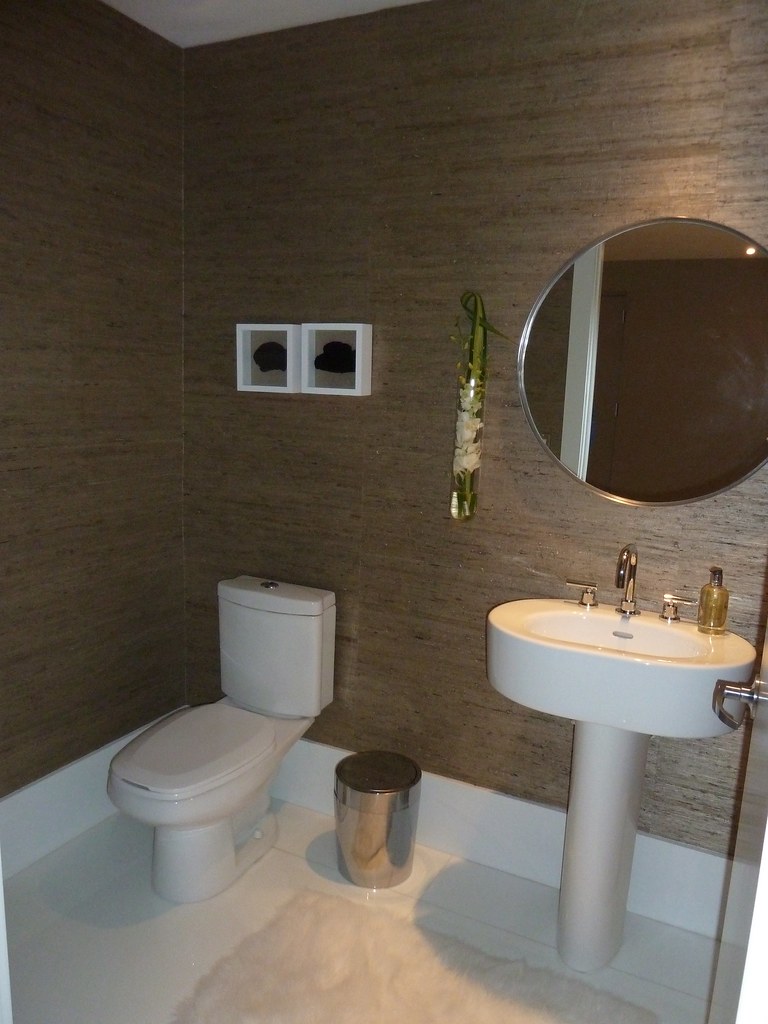
Photo: miamism, CC BY 2.0, via Flickr

Photo: Shixart1985, CC BY 2.0, via Wikimedia Commons

Photo: Jeremy Levine Design, CC BY 2.0, via Flickr

Photo: tommerton2010, CC BY 2.0, via Flickr

Photo: daveynin, CC BY 2.0, via Wikimedia Commons
Sources
- National Kitchen and Bath Association (NKBA) — Bathroom Planning Guidelines: toilet clearances and fixture spacing standards
- International Residential Code (IRC) — Bathroom mechanical ventilation requirements
- National Association of Home Builders (NAHB) — Remodelling impact data on home resale value
- Illuminating Engineering Society (IESNA) — Lighting Handbook: recommended colour temperatures for residential bathrooms

No comments:
Post a Comment