Good front yard garden design starts with a simple truth: the space in front of your house is the first thing guests, neighbors, and buyers see, and it should make the walk to your door feel easy and inviting. You do not need a large budget, a designer, or a perfect lawn to get there. You need a clear plan, plants that fit your sun and soil, and a few strong choices repeated with care. When those pieces work together, even a small patch of ground can look calm, cared for, and truly welcoming.
Before you buy a single plant, walk your yard at different times of day. Notice where the morning sun falls, where the hot afternoon sun hits the house, where water pools after rain, and where people already walk from the sidewalk to the door. Measure the width of the yard, the distance from the gate to the steps, and the height of your windows. Those simple notes will save you money, because they stop you from buying shade plants for a sunny spot, or a tree that will one day block your windows, your view, or your driveway.

Photo via Wikimedia Commons. A planted front garden with red and white tulips, shrubs, and steps leading to a house porch.
Contents:
- 1. Build Layered Foundation Beds
- 2. Make a Wide, Welcoming Walkway
- 3. Plan the View From the Street
- 4. Plan Color for All Four Seasons
- 5. Choose Low-Water Planting Where It Fits
- 6. Give the Eye One Strong Focal Point
- 7. Plant a Pollinator-Friendly Border
- 8. Keep a Smaller, Tidier Lawn
- 9. Add Color Right at the Doorstep
- 10. Light the Yard Softly for the Evening
- Frequently Asked Questions
- Final Thoughts
- Sources
- Gallery
1. Build Layered Foundation Beds

Photo via Wikimedia Commons. A layered garden with lawn, shrubs, a stone urn, and tall trees.
Layering is the fastest way to make a front garden look planned instead of random. Put the tallest plants at the back, near the house, medium shrubs and perennials in the middle, and low plants at the front edge, so every plant can be seen and none hides the others. Make foundation beds 4 to 6 feet deep, not a thin 18-inch strip, so shrubs have room to reach their full size without crowding the house. Keep plants near windows trimmed to about 3 to 4 feet tall, so light still comes in, the house stays visible, and no dense shrub gives cover right beside a window.
Start with an evergreen backbone, such as boxwood, holly, yew, or juniper in your zone, because evergreens hold the shape of the bed all winter when flowers are gone. Then repeat just three to five plant types across the beds, instead of buying one of everything at the garden center. Space each plant by the mature width printed on its tag, not by how small it looks in the pot, and spread 2 to 3 inches of mulch to hold moisture and slow weeds. The same zone thinking used in our backyard garden design ideas guide works here too, because grouping plants by sun, water, and size is what keeps a bed looking calm year after year.
2. Make a Wide, Welcoming Walkway

Photo via Wikimedia Commons. A wide brick path lined with yellow daffodils and young trees in a garden.
A walkway should be wide, clear, and easy to follow, because it is the part of the yard every visitor actually uses. Make the main path 4 to 5 feet wide, so two people can walk side by side and you can carry groceries or push a stroller without stepping into a bed. Keep the route direct, with one gentle curve at most, and watch where feet already go: a pretty path that nobody uses will soon be joined by a worn shortcut across the lawn. Use a firm, level surface such as concrete, pavers, flagstone, or brick, add edging to stop gravel or mulch from spreading, and slope the surface slightly away from the house so water drains off instead of pooling at the door.
Secondary garden paths can be narrower, at least 3 feet wide, but they still need a clear edge and a surface that stays safe when wet. Line the main walk with low plants that will not flop over it or block the view at the driveway, and keep sight lines open where cars, bikes, and walkers meet. If you are still sketching the whole property, our guide to designing the landscape walks through measuring, zoning, and placing paths before you plant, which is the order that saves the most rework. A clean, generous walk does more for curb appeal than any single flower, because it tells every guest exactly where to go.
3. Plan the View From the Street

Photo via Wikimedia Commons. A house seen from the street with a wide driveway, lawn, and garden beds along the front.
Step across the street and look back at your house, because that is the view most people will remember. Ask yourself what your eye lands on first: is it the front door, a healthy tree, or a bare wall, a trash bin, or a tired patch of lawn? Move bins and hoses out of sight, trim any shrub that hides the door or the house number, and give the entry one clear focal point, such as a pair of matching planters, a small tree, or a bright bed near the steps. Take a phone photo from the sidewalk too, since a photo often shows clutter, bare spots, and uneven edges that you miss when you look at the yard every day.
Match the scale of your planting to the size of your house. A small ranch or cottage can be overwhelmed by one huge shrub, while a tall two-story house needs larger beds and a tree or two to balance its height. Repeat a color from the door, the trim, or the roof in a few flowers or pots, so the house and the garden feel like one place instead of two separate projects. Leave the front door easy to see and easy to reach, with no plant blocking the steps, the mailbox, or the path, and your whole front yard will read as cared for, even before anyone steps inside.
4. Plan Color for All Four Seasons
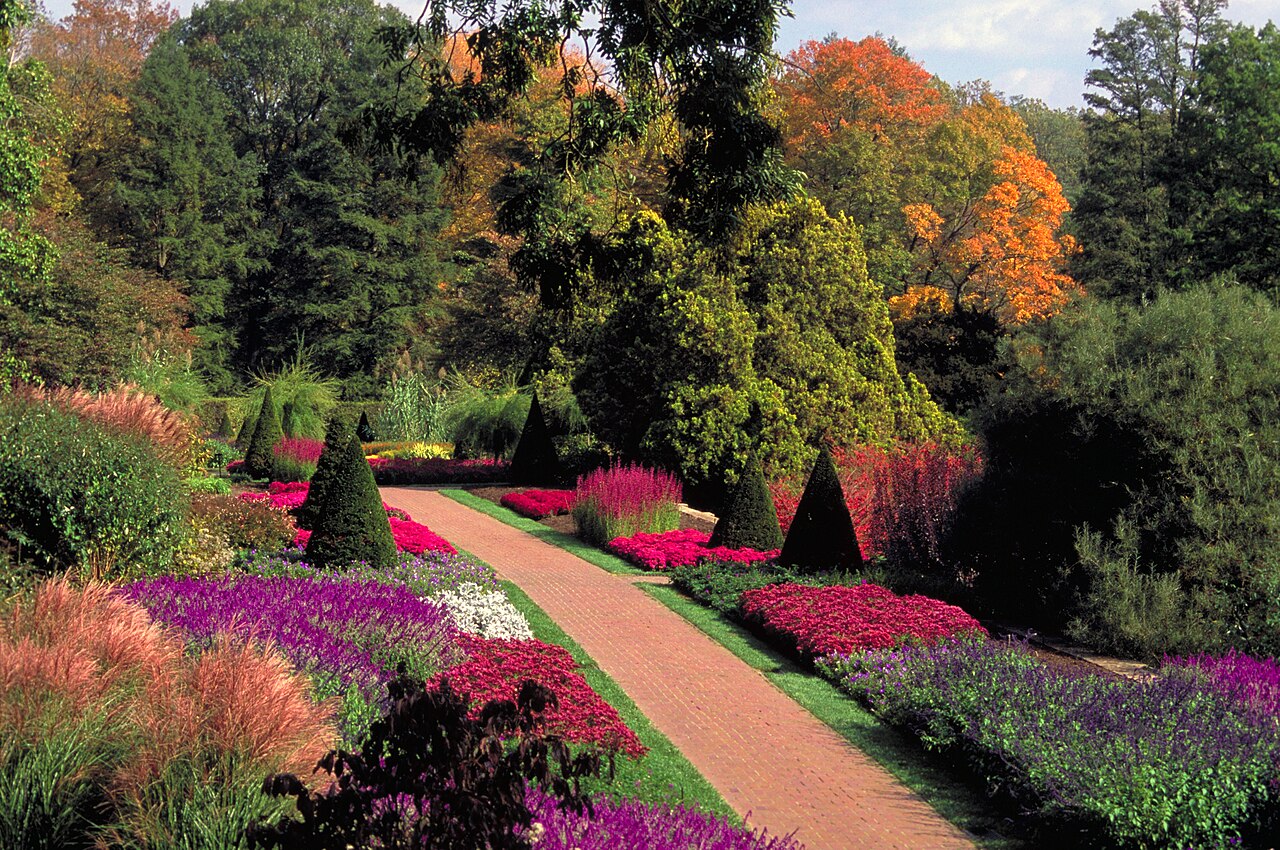
Photo via Wikimedia Commons. A garden path lined with colorful flower beds, cone-shaped evergreens, and trees with autumn color.
Many front yards look lovely for three weeks in spring and then fade, because every plant blooms at the same time. Plan a simple bloom calendar instead. Start with spring bulbs such as daffodils and tulips, add summer perennials such as coneflowers, daylilies, and salvia, and finish with fall color from ornamental grasses, asters, and shrubs with red or gold leaves. For winter, lean on evergreens, red-twig dogwood, winterberry, and ornamental grasses left standing, so the yard still has shape and color when the flowers are gone. Check your USDA hardiness zone before you fall in love with a plant tag, and pick varieties that are hardy where you live.
Limit your color palette to two or three main colors, plus green, so the yard looks calm rather than busy. Plant in groups of three, five, or seven of the same variety, and repeat those groups along the bed, because a drift of one flower reads far better from the street than twenty single plants scattered about. If a bed looks empty in its first year, fill the gaps with low-cost annuals such as marigolds, petunias, or zinnias, and pull them out as the perennials grow in. That one habit, repeated color in generous groups, is what makes a modest front garden look like it was planted by someone who knew exactly what they were doing.
5. Choose Low-Water Planting Where It Fits

Photo via Wikimedia Commons. A gravel bed planted with yellow and orange drought-tolerant flowers and grasses.
A low-water front garden is not a dry, bare yard. It is a garden where plants are grouped by thirst, so thirsty plants sit near the house where they are easy to water, and tough plants sit at the hot street edge where reflected heat from the road dries the soil fastest. Good choices for dry, sunny spots include lavender, salvia, sedum, ornamental grasses, yarrow, and native plants suited to your region, while shady, damp spots suit hostas, ferns, and astilbe. Cover bare soil with 2 to 3 inches of mulch, which keeps roots cool, cuts evaporation, and stops weeds, and top it up once a year because mulch breaks down.
Water deeply and less often, rather than a light sprinkle every day, so roots grow down instead of staying near the surface. Drip irrigation or a soaker hose puts water at the roots with far less loss to wind and sun than a sprinkler, and a simple timer set for early morning works better than watering in the heat of the day. Before you plant a large bed, get a low-cost soil test from your local extension office, since clay soil holds water and sandy soil drains fast, and both need different help. In a hot, dry climate, gravel, crushed stone, and stepping stones can replace part of a thirsty lawn, but keep some green in the plan, because a yard that is all stone looks hot and hard in summer.
6. Give the Eye One Strong Focal Point

Photo via Wikimedia Commons. Leafy green arches over a grass path in a garden, shown before bloom.
Every good front garden has one place where the eye can rest, and just one is usually enough. It might be a small flowering tree, a rose-covered arbor over the walk, a stone urn, a bench tucked under a tree, or a single large pot by the door. Place it about two-thirds of the way along the main view from the street or the porch, not dead center, and connect it to the rest of the yard by repeating its shape or color somewhere nearby. A 6 to 8 foot arbor suits a small yard, while a larger property can carry a taller pergola or a multi-stem tree, but the scale must fit the house, or the feature will look lost or oversized.
If you choose an arbor, anchor its posts firmly and keep the walk clear underneath, so guests do not duck under low vines. Climbing roses, clematis, and Carolina jasmine all suit an arbor, but they need pruning each year to stay tidy and to keep blooms where you can see them. A specimen tree needs the same care in choosing: plant small trees at least 15 feet from the house, and medium or large trees 30 to 50 feet away, so growing roots do not damage the foundation. Call 811 before you dig, so underground lines are marked for free, and you will never have to move a focal point you just planted.
7. Plant a Pollinator-Friendly Border

Photo via Wikimedia Commons. A perennial border with pale pink Japanese anemone flowers and green foliage.
A pollinator border is one of the most rewarding parts of a front garden, because it brings bees, butterflies, and hummingbirds right to your doorstep. Choose a sunny spot and plant a mix that blooms from spring through fall, such as native milkweed for monarchs, coneflower, black-eyed Susan, salvia, bee balm, and asters for late-season food. Plant each type in a group, not as a single stem, so pollinators can find it easily, and leave some seed heads standing into fall and winter, since birds feed on them and many helpful insects shelter in hollow stems. Skip pesticides on this border when you can, and if you must treat a pest, do it in the evening when bees are less active.
Ask your local nursery or extension office which native plants grow well in your town, because a plant that thrives in humid Georgia may struggle in dry Colorado or cold Minnesota. Group plants with similar sun and water needs together, and give new plants a deep soak once or twice a week in their first season, rather than a daily sprinkle. If deer visit your street, lean on plants they tend to avoid, such as salvia, catmint, lavender, and ornamental grasses, and keep the border near the house where you can enjoy it. A pollinator bed does not need to look wild or messy: clean edges, repeated groups, and a mown path beside it keep it looking neat from the sidewalk.
8. Keep a Smaller, Tidier Lawn

Photo via Wikimedia Commons. Green front lawns, a sidewalk, and houses across a street, with a flower bed in the foreground.
A lawn is lovely to look at and great for kids and pets, but it is also the thirstiest and most work-heavy part of most front yards, so decide with your eyes open. If you keep lawn, choose a grass type for your climate, mow high at about 3 inches, and never cut off more than a third of the height at once, because longer grass shades its own roots, holds moisture, and crowds out weeds. Leave the clippings on the lawn where they feed the soil, water deeply about 1 inch per week when rain does not supply it, and edge the lawn cleanly where it meets beds and paths, since a crisp edge alone can make a whole yard look cared for.
Going smaller with lawn often looks better than keeping a whole yard of tired grass. A neat, well-shaped patch framed by garden beds gives you open green space without hours of mowing, watering, and feeding, and the rest can become groundcovers such as creeping thyme, clover, or sedum in sun, or sedge and pachysandra in shade. Groundcovers still need weeding in their first year until they knit together, so do not believe any claim that a lawn-free yard needs no work at all. The real saving is less mowing and less water over time, and a front yard that keeps some open green always feels softer and more welcoming than one that is paved from fence to fence.
9. Add Color Right at the Doorstep

Photo via Wikimedia Commons. Red roses and petunias blooming in a mulched flower bed.
The last few feet before the door deserve the most color, because that is where guests slow down and look closely. Flank the door with two matching pots, fill window boxes with the same flowers as the beds below them, and pick a color that echoes the door, the trim, or the house number plaque. Use large pots, at least 14 to 16 inches wide, since small pots dry out fast in summer heat, and make sure every pot has a drainage hole. A simple recipe works well: one tall plant in the middle, a few full plants around it, and one trailing plant spilling over the edge, all in the same two or three colors as the rest of the yard.
Change the pots with the seasons, using pansies and violas in cool weather and petunias, geraniums, or lantana in summer heat, and check the soil daily in hot spells, since pots dry out much faster than garden beds. Keep the steps, the house number, and the mailbox clear and easy to see, and keep mailbox plants low, under about 24 inches, so they do not block the mail carrier or hide the box. A fresh doormat, clean house numbers, and two healthy pots can lift an entry more than a whole new bed, and they cost far less, which is why designers start at the door when a budget is tight.
10. Light the Yard Softly for the Evening

Photo via Wikimedia Commons. Warm white string lights on the bare branches of a tree at night.
Good front yard lighting has one job first: helping people see the path, the steps, and the door safely after dark. Start with low path lights spaced 6 to 8 feet apart along the walk, a light at the door that does not shine into visitors eyes, and one uplight on a feature tree or the house front if you want a focal point. Use warm white light, around 2700 to 3000 Kelvin, which looks welcoming and natural, while harsh blue-white light makes a garden look cold and can annoy neighbors. Put everything on a timer or sensor, so lights run from dusk to about 11 pm instead of all night, which saves power and is kinder to wildlife.
Solar lights are the easiest do-it-yourself option for paths and beds, but they fade on cloudy days and need their panels kept clean and in sun, while low-voltage wired kits cost more up front, usually $80 to $200 for a starter set, and give steadier, brighter light. Keep fixtures low, aim them down at plants and paths, and never aim spotlights across the sidewalk or into a neighbor bedroom window. Bury or tuck wires out of the mowing path, check your homeowners association rules before you add permanent fixtures, and keep the total simple: three quiet pools of light will make a yard feel twice as deep after dark, while a dozen bright lights will only make it look busy.
Frequently Asked Questions
Where should I start with a front garden?
Measure the yard, note sun, shade, soil, and drainage, call 811 to mark underground lines, and sketch a simple plan on paper before you buy plants. That one sketch stops the most common mistake, which is buying plants one at a time and ending up with a scattered collection instead of a garden.
How much does a simple front yard makeover cost?
A do-it-yourself bed refresh with mulch, edging, and a dozen plants can run $300 to $800, while a medium refresh with a new path, beds, and shrubs often runs $2,000 to $8,000. Full professional work with patios and lighting usually starts around $15,000, so start with one bed or one path and add more over two or three seasons.
What if my front yard is small or shady?
Use fewer but larger beds, one diagonal or gently curved path, and containers by the door to add color without digging new beds. For shade, try hostas, ferns, astilbe, heuchera, and shade-tolerant groundcovers, and keep the palette simple so a small space reads as calm, not crowded.
How do I keep a front garden low maintenance?
Pick evergreens for structure, native plants for your zone, and repeat just a few types, so care stays simple. Mulch 2 to 3 inches deep, water with drip lines, group plants by thirst, and accept that a tidy garden still needs a spring cleanup, a summer trim, and a fall tidy, just far less work than a yard full of fussy plants.
Do I need permission before I change the front yard?
Check your homeowners association rules, city setback and fence-height rules, and sight-line rules at driveways and corners before you build or plant tall screening. Always call 811 before you dig, keep clear of power lines when choosing trees, and ask first if a path, fence, or driveway change crosses a sidewalk or public strip.
Final Thoughts
You do not need a design degree or a five-figure budget to get a front garden that works. Measure first, zone by how you actually live, build the hard surfaces before the soft ones, and plant in groups with room to grow. Take it one bed, one path, or one season at a time, and every round will look better than the last, because the plants will be in the right spots and the shape of the yard will already be set.
The biggest secret of a welcoming front garden is that it is mostly decisions, not dollars. Choose fewer plants and repeat them, keep the walk wide and the door visible, give the yard color in every season, and light it softly at night. Do those few things well, and your home will greet every guest, neighbor, and passerby with the same calm, cared-for feeling, every single day of the year.
Sources
- HGTV — Small Front Yard Landscaping Ideas
- The Home Depot — Front Yard Landscaping Ideas
- Ware Landscaping — Front Yard Design Ideas for U.S. Homes
- USDA — 2023 USDA Plant Hardiness Zone Map
Gallery

Photo via Wikimedia Commons. A gravel path lined with ferns leading to a house porch, with a large boulder in the garden.

Photo via Wikimedia Commons. A front garden with tall trees, shrubs, and flower beds along a street in Ann Arbor, Michigan.

Photo via Wikimedia Commons. Clipped hedges and a small bare-branched tree in a front garden.

No comments:
Post a Comment