A great board looks fancy, but it is really just simple math plus a little arranging. These charcuterie board ideas work for any party size, from a quiet date night for two to a big grazing table for thirty people. Each one gives you exact amounts per person, real store prices, and clear steps, so you never buy too much or run out halfway through the party.
The most important rule is this: plan 2 ounces of meat and 2 ounces of cheese per person when other food will be served, and 3 ounces of each when the board is the main food. Keep that one rule in mind and every board below becomes easy. Pick the style that fits your guests, follow the amounts, and you will build a board that looks generous and tastes balanced every single time.

Photo: Shixart1985 / Wikimedia Commons (CC BY 2.0)
Table of Contents
- 1. The Classic Formula Board
- 2. The Budget Board Under $30
- 3. Date Night Board for Two
- 4. The Big Party Grazing Board
- 5. The Breakfast Board
- 6. The Dessert Board
- 7. The Mediterranean Mezze Board
- 8. The Cheese-Only Board
- 9. The Kid-Friendly Snack Board
- 10. The Make-Ahead Board That Travels Well
- FAQs
- Final Thoughts
1. The Classic Formula Board

Photo: T.Tseng / Wikimedia Commons (CC BY 2.0)
The classic board follows the famous 3-3-3-3 rule: 3 meats, 3 cheeses, 3 breads or crackers, and 3 extras. For 6 guests as an appetizer, buy 12 ounces of meat total (try hard salami, prosciutto, and soppressata) and 12 ounces of cheese (a small brie wheel, aged cheddar, and manchego). That shopping list costs about $22 to $28 at most supermarkets. Add a baguette, water crackers, and breadsticks for the starches, then green olives, cornichon pickles, and a small jar of fig jam for the extras.
Build it in this order: set the jam and olive bowls on the board first, place the cheeses in three corners, then fan and fold the meats in loose ribbons between them. Fill every gap with crackers, grapes, and a handful of walnuts so the board looks full, not sparse. Take the cheese out of the fridge 45 minutes before guests arrive so it softens and tastes its best. Once the board goes out, start a quiet timer: two hours at room temperature is the safe limit, and after that the leftovers should be packed away or thrown out.
2. The Budget Board Under $30

Photo: Ddolacki / Wikimedia Commons (CC BY-SA 4.0)
A good board does not need expensive imports. Here is a real shopping list for 6 to 8 snackers that stays under $30: a block of sharp cheddar ($2.50), fresh mozzarella ($2.25), a salami chub you slice yourself ($4), pepperoni slices ($3), store-brand crackers ($1.50), a baguette ($1.50), red grapes ($2), a jar of pickles ($1.75), mixed nuts ($3), and grainy mustard ($1). The total comes to about $23.50, which leaves room for one small treat like honey or dried apricots.
Three habits keep the price down. First, buy cheese in blocks and slice it yourself, because pre-sliced cheese often costs 30 to 40 percent more for the same weight. Second, pick only one "hero" item, such as a small brie, and let cheap fillers like popcorn, carrot sticks, and extra crackers make the board look big. Third, shop the store brand for crackers and nuts, where quality is nearly the same. Keep all the deli meat in the fridge until 30 minutes before serving in summer, and remember the two-hour rule once it sits out.
3. Date Night Board for Two

Photo: Binibinipicnic / Wikimedia Commons (CC0)
For two people, small is better. Use a 10 to 12 inch board and buy about 6 ounces of meat and 6 ounces of cheese in total, which is a light meal for a couple. Good picks are prosciutto and a mild salami for the meats, plus a mini brie and a small piece of aged gouda for the cheeses. Add strawberries, a small bunch of grapes, a tiny pot of jam, and a few squares of dark chocolate. The whole board costs about $15 to $20, less than one takeout pizza.
The pretty trick in the photo is the salami rose: fold slices over the rim of a small glass, overlap them halfway around, then flip the glass over and lift it off. Two roses, a fanned cheese wedge, and fruit tucked into the gaps take five minutes to arrange. Because a date night board sits out while you talk, keep it small and keep the rest of the meat and cheese in the fridge for a fresh second round. Anything still sitting out after two hours should be tossed, not saved for tomorrow.
4. The Big Party Grazing Board
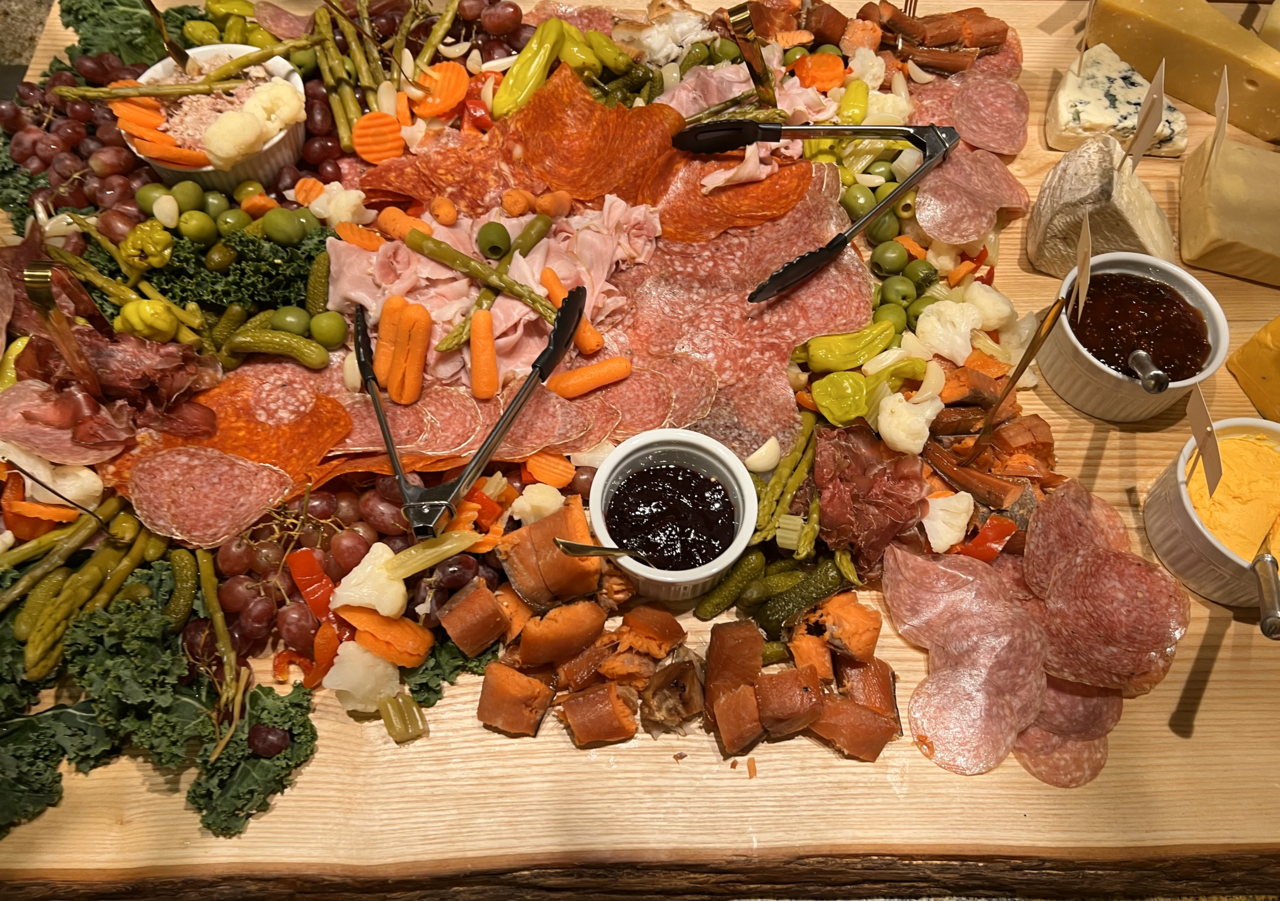
Photo: TammyBellBells / Wikimedia Commons (CC BY-SA 4.0)
Feeding a crowd is a math problem, not a talent problem. The formula still works: 2 ounces of meat and 2 ounces of cheese per person for an appetizer board. For 20 guests that means about 2¾ pounds of meat and 3 pounds of cheese. For 30 guests, plan 4¼ pounds of meat and 4½ pounds of cheese, plus 10 percent extra because big groups always have a few heavy grazers. Expect to spend $150 to $220 for 25 guests, roughly $6 to $9 per person, using 3 meats and 4 cheeses.
Do not build one giant board. Two or three medium boards set at different spots stop the traffic jam and look fresher for longer. Keep a backup tray of sliced meat and cheese in the fridge and refill in small amounts. Set a timer for two hours; when it rings, swap in the fresh tray and retire the old one. Small tent labels for the cheeses help guests with allergies, and if you want more starters around the table, these easy appetizer ideas guests will love pair well with a big board.
5. The Breakfast Board

Photo: Sarah Stierch / Wikimedia Commons (CC BY 4.0)
A breakfast board turns a slow morning into a small event, and it is mostly assembly, not cooking. For each person, plan 2 mini waffles or pancakes, 2 strips of bacon or 2 sausage links, 1 hard-boiled or scrambled egg, ½ cup of mixed berries, and a small 4-ounce yogurt cup. Add bagels with cream cheese, a sliced cheese like cheddar or gouda, and a few slices of ham or smoked salmon for the brunch feel. For 6 people, the groceries cost about $25 to $32, and the only real cooking is the bacon and the eggs.
Timing matters more here than on any other board. Put the cold items out first, then add hot food last so it stays warm. Hot items should stay above 140°F, so use a warm tray or serve bacon and eggs in two small batches about 45 minutes apart. Yogurt, cheese, and cut fruit follow the same two-hour room-temperature limit. For a cozy cold-weather spread, these winter brunch ideas give you more warm dishes that sit happily next to a breakfast board.
6. The Dessert Board

Photo: The Berry Dairy / Wikimedia Commons (CC BY-SA 4.0)
The dessert board follows the same logic as the savory one: something rich, something fresh, something crunchy, and a dip in the middle. For 8 guests, plan 4 to 5 sweet bites per person plus about ¼ cup of dip each. A proven mix is brownie bites, chocolate-covered strawberries, shortbread cookies, big marshmallows, caramel popcorn, and a warm bowl of chocolate fondue or Nutella thinned with a spoon of cream. The shopping cost lands around $25 to $35, and most of it can be store-bought without shame.
Build it on a cool board away from sun or oven heat, because chocolate softens fast. Set the warm dip in the center, ring it with brownies and cookies, then fill the gaps with berries and popcorn so sweet and fresh bites alternate. Anything with whipped cream or soft serve follows the two-hour rule too, so keep extra berries and popcorn in the kitchen for a mid-party refresh. If fruit desserts are your favorite finish, these apple dessert ideas include caramel apple slices that were born to sit on a board like this.
7. The Mediterranean Mezze Board

Photo: Satdeep Gill / Wikimedia Commons (CC BY-SA 4.0)
The mezze board is the friendliest board for mixed groups, because half of it is naturally vegetarian. For 6 people, plan 1½ cups of hummus, 1 cup of tzatziki, 1 cup of whipped feta, 8 ounces of feta cubes or mozzarella balls, a cup of mixed olives, 12 stuffed grape leaves, cucumber sticks, cherry tomatoes, and plenty of warm pita cut into triangles. If your group eats meat, add 6 ounces of soppressata or sliced salami on one side only. The full spread costs about $26 to $30, and the dips do most of the work.
Arrange the three dips in bowls across the board first, then pile the pita in two stacks and fan the vegetables and grape leaves in the spaces between. Add the pita last, warmed for 5 minutes at 350°F, so it stays soft instead of drying out. Cold dips are dairy and follow the two-hour rule; at an outdoor party, nest the dip bowls in a tray of ice and the board can safely graze longer. A squeeze of lemon and a drizzle of olive oil over the hummus right before serving makes store-bought dip taste homemade.
8. The Cheese-Only Board

Photo: Daderot / Wikimedia Commons (CC0)
Skip the meat and let cheese be the whole show. The rule is variety across texture and strength: one soft cheese (brie or camembert), one semi-soft (havarti or young gouda), one hard cheese (aged cheddar, manchego, or parmesan), one blue (gorgonzola dolce is the gentle choice), and one flavored wild card like a cranberry or herb cheese. Because cheese is the main food here, plan 3 ounces per person as an appetizer and 4 ounces if the board is the meal. For 6 guests that is about 1¼ pounds of cheese, costing $18 to $30.
Cut the hard cheeses into slices or sticks before guests arrive, but leave soft wheels whole with their own knife so they do not collapse. Pull everything from the fridge 45 to 60 minutes before serving; cold cheese tastes muted, and this hour at room temperature is part of the plan, not a safety risk. Set honey next to the blue cheese and fig jam next to the manchego, because those two pairings win every time. Small labels with the cheese names stop the same question all night and help anyone avoiding a strong blue.
9. The Kid-Friendly Snack Board

Photo: Joli Rumi / Wikimedia Commons (CC BY-SA 4.0)
Kids graze better from a board with clear sections than from a big fancy spread, so a compartment tray or muffin tin works perfectly. Fill it with cheddar cubes, string cheese, rolled turkey and ham slices, mini crackers, pretzels, cucumber sticks, carrot sticks, bell pepper strips, hummus or ranch for dipping, apple slices, and berries. Plan about 1 ounce of cheese and 1 ounce of meat per child, plus two big handfuls of the crunchy and fresh items. The whole tray for 6 kids costs about $18 to $22.
Safety needs a little extra thought with small children. Cut grapes and cherry tomatoes lengthwise into quarters for anyone under 4, because whole round foods are a choking risk. Skip whole nuts for children under 5, and use sunflower seeds or soft cheese cubes instead. Keep the board at kid height on a stable table, set it out when the kids are actually hungry, and pull perishable items back to the fridge after two hours like any other board. One parent-approved trick: let each child pick one "brave bite," like an olive, to try first.
10. The Make-Ahead Board That Travels Well

Photo: Binibinipicnic / Wikimedia Commons (CC0)
The smartest party move is building the board somewhere it can travel: inside a flat lidded box, a rimmed sheet pan, or a board with raised edges. The night before, slice the hard cheeses, fold the salami ribbons, wash the grapes, and store each item in its own covered container in the fridge. In the morning, line the box with parchment, set the dip bowls, arrange the cheese and meat, and fill the gaps with nuts, dried fruit, and olives. Crackers travel in a separate bag and go on only when you arrive, so they stay crisp.
Transport is where food safety is won or lost. Keep the box flat in a cooler or on top of two frozen ice packs so the food stays at or below 40°F on the drive, and start your two-hour room-temperature clock when the box comes out at the party, not when you leave home. Give yourself 10 minutes at the other end to add crackers, fresh herbs, and the jam. This is also the exact method that works for picnics and park days, and these outdoor picnic food ideas round out the rest of the menu.
FAQs
How much meat and cheese do I need per person?
Plan 2 ounces of meat and 2 ounces of cheese per person when a meal or other food will also be served. If the board is the main food, raise it to 3 ounces of each, and if the board is dinner itself, plan 4 ounces of each. For groups of 20 or more, add 10 percent extra, and if you have to choose, buy extra meat: it always runs out before the cheese.
How long can a charcuterie board sit out?
Two hours at normal room temperature is the limit set by USDA food safety guidance for perishable foods like sliced meat, cheese, and dips. If the room or yard is above 90°F, the limit drops to one hour. For longer parties, build a smaller board, keep a refill tray in the fridge, and swap in fresh food before the clock runs out instead of topping up the old board.
What size board do I need?
A 10 to 12 inch board suits 2 people, a 15 to 18 inch board suits 6 to 8, and for 10 or more guests, use two boards or a rimmed sheet pan per group of 10. Crowding is fine and even looks good, but you should still be able to see a little of the board at the edges when you start. You do not need a special board at all: a clean cutting board, a platter, or parchment laid straight on the table all work.
Can I make a board the day before?
You can do almost all of the work the day before. Slice hard cheeses, portion the meats, wash fruit, and make dips up to 24 hours ahead, then store everything in separate covered containers in the fridge. Assemble the board a few hours before the party at most, keep it wrapped in the fridge, and add crackers, bread, nuts, and popcorn only at serving time so they stay crisp.
What should I buy first if my budget is small?
Buy the cheese first, starting with one soft and one hard cheese, because cheese sets the flavor of the whole board. Next buy one good salami, then cheap bulk: crackers, grapes, and pickles. Fill space with popcorn, carrot sticks, and store-brand nuts instead of a second fancy meat. A $25 board built in that order tastes far better than a $40 board spent mostly on crackers and jars.
Final Thoughts
Good boards are not about expensive shopping or special talent. They are about the simple formula: the right ounces per person, a mix of soft and firm, salty and sweet, and respect for the two-hour clock. Start with one of the charcuterie board ideas above that matches your party size, follow the amounts exactly the first time, and take one photo of your finished board. Next time you will adjust it to your own taste in minutes, and your guests will think you have been doing it for years.
Sources
- How Much Charcuterie Per Person? Chart for 4 to 30+ Guests — Charcuterie Lab
- How Long Can a Charcuterie Board Sit Out? — Amazing Charcuterie Boards
- Tips for a Festive Charcuterie Board — Kansas State University
- How to Make the Perfect Charcuterie Board — Jennifer Cooks
Gallery

Italian antipasti boards with cheese and cured meats. Photo: ArsenG / Wikimedia Commons (CC BY-SA 4.0)

A simple three-cheese plate with grapes. Photo: Missvain / Wikimedia Commons (CC BY 4.0)

A French-style slate with pâté, meats and cornichons. Photo: Daderot / Wikimedia Commons (CC0)

No comments:
Post a Comment