A 3x3 garden is simply a 3-foot-by-3-foot raised bed divided into nine one-foot squares. It is the smallest version of the square-foot gardening method, and it fits almost anywhere: a sunny patio corner, the side of a driveway, or a strip of lawn you are tired of mowing. One bed, nine squares, and you are growing real food.
The beauty of this little bed is that every square sits within arm's reach, so you never step on the soil, weeding takes minutes, and one watering can does the whole job. The 14 ideas below walk you from lumber and soil mix all the way to succession planting and season extension, so your first bed succeeds in its very first season.
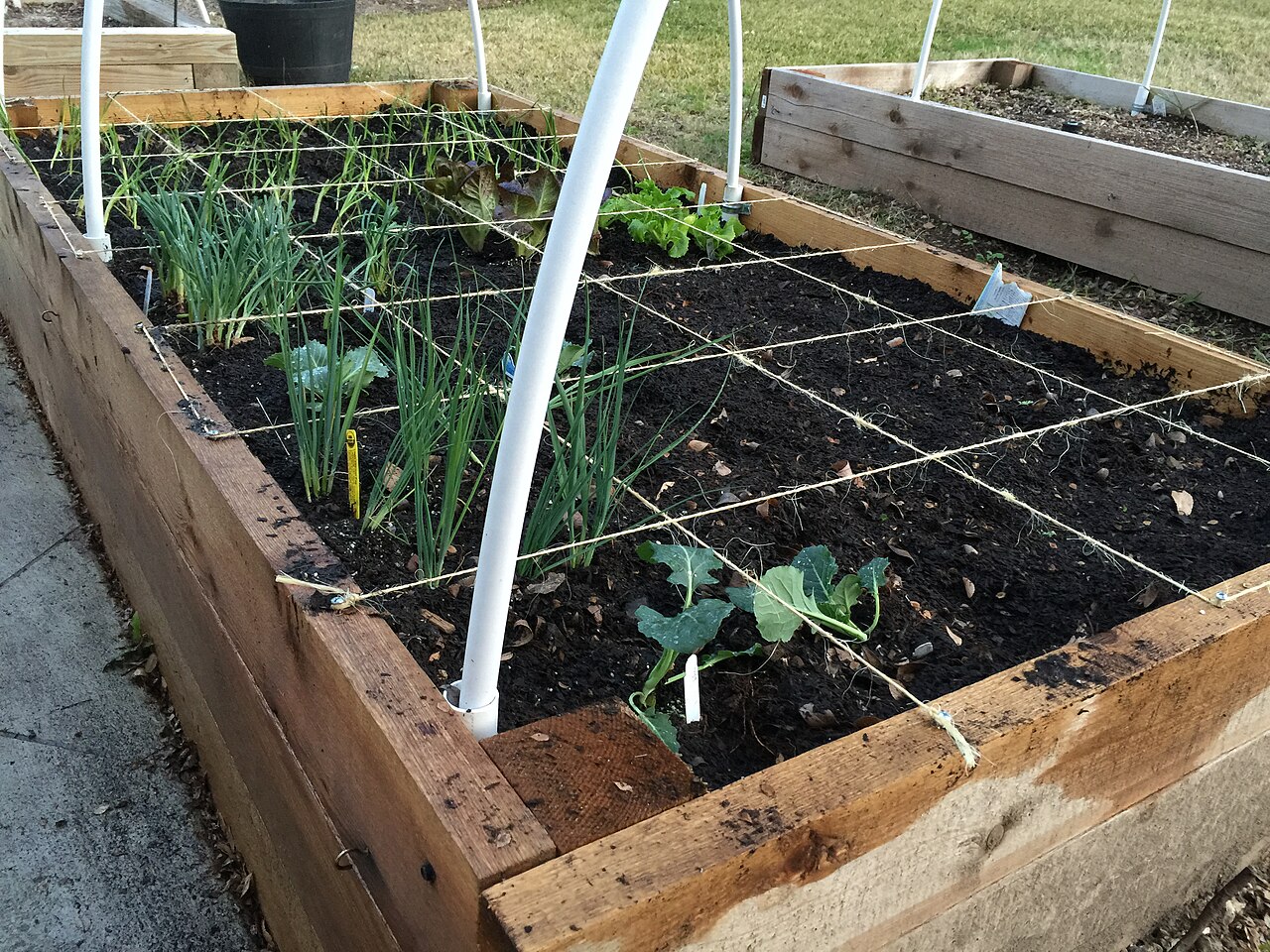
Photo via Wikimedia Commons
Table of Contents
- 1. Why a 3-Foot Square Is the Perfect Starter Size
- 2. Build a Simple Untreated-Lumber Frame
- 3. Fill It with Mel's Mix
- 4. Lay Out the 9-Square Grid
- 5. Learn the 1-4-9-16 Spacing Rule
- 6. Give It 6 to 8 Hours of Sun
- 7. Water Small and Often
- 8. Start with These Easy Crops
- 9. Grow Up, Not Out, on the North Side
- 10. Succession Plant for a Longer Harvest
- 11. Pair Plants That Help Each Other
- 12. Keep Pests Out the Easy Way
- 13. Mulch the Bare Soil
- 14. Stretch the Season with a Row Cover
1. Why a 3-Foot Square Is the Perfect Starter Size
Nine square feet sounds tiny, but it holds nine different crops at once — one per square. A full 4-by-8-foot bed can overwhelm a beginner with weeding and watering, while a 3-ft square asks for about 15 minutes of care a day at peak season. It is also cheap to fill: one trip to the garden center covers the whole bed.
Reach is the real win. Most adults can comfortably reach about 2 feet, so from any side you can touch the middle square without ever stepping into the bed. No paths, no compacted soil, no wasted space — just nine productive squares you can manage from your lawn chair.

Photo via Wikimedia Commons
2. Build a Simple Untreated-Lumber Frame
Cut four boards to 3 feet long and screw the corners together with 3-inch exterior deck screws — eight screws total, and the whole frame goes together in under an hour. Two stacked 2x6 boards per side give you a 12-inch-deep bed; a single 2x6 gives you 6 inches, which is fine for lettuce and herbs.
Use untreated cedar or redwood if you can; plain pine is fine on a budget and usually costs $20 to $30 for the lumber. Skip railroad ties and old painted boards, since creosote and old paint can leach into soil where food grows.

Photo via Wikimedia Commons
3. Fill It with Mel's Mix
Square-foot gardening founder Mel Bartholomew's famous recipe is equal parts blended compost, peat moss (or coco coir), and coarse vermiculite. A 3-by-3 bed that is 6 inches deep needs about 4.5 cubic feet of mix — roughly 1.5 cubic feet of each ingredient — and a 12-inch-deep bed needs about 9 cubic feet.
Dump the ingredients straight into the frame and blend them with a rake, then water deeply and let the bed settle for a day before planting. Top up with an inch of fresh compost each season; this mix stays loose for years and never needs digging.

Photo via Wikimedia Commons
4. Lay Out the 9-Square Grid
Stretch string, twine, or thin wood lath across the bed to mark nine 1-foot squares, pinning the lines to the frame with small nails. The grid is the whole trick of the method: each square becomes its own mini-plot with its own crop and its own spacing.
Keep the grid visible all season, because it tells you exactly where to plant, where to thin, and where to replant. When one square finishes producing, you pull it and replant just that square — the rest of the bed keeps growing undisturbed.

Photo via Wikimedia Commons
5. Learn the 1-4-9-16 Spacing Rule
Big plants like tomatoes, peppers, and broccoli get 1 per square; medium plants like lettuce, basil, and chard get 4; small plants like bush beans, beets, and spinach get 9; tiny plants like carrots, radishes, and green onions get 16. A handy shortcut: divide 12 inches by the spacing on the seed packet to get plants per side, then square it.
One square of carrots at 16 per square can yield well over a pound of roots. Planting this densely shades the soil quickly, which means far fewer weeds than old-fashioned rows — the plants become their own living mulch.

Photo via Wikimedia Commons
6. Give It 6 to 8 Hours of Sun
Most vegetables need at least 6 hours of direct sun a day; fruiting crops like tomatoes and peppers do best with 8. Before you build, watch your chosen spot for one full day — morning sun with a little afternoon shade is actually ideal in very hot climates.
A 3-ft bed is easy to place perfectly: tuck it against a south-facing wall or fence for extra reflected warmth, and keep it clear of trees and shrubs whose roots will steal water from your small pocket of soil.

Photo via Wikimedia Commons
7. Water Small and Often
Raised beds drain fast and dry out faster than ground soil, so check your bed daily in summer: push a finger 2 inches down, and if it feels dry, water. A 3-by-3 bed drinks roughly 2 to 3 gallons per watering — about one full large watering can.
Water the soil, not the leaves, and do it early in the morning so foliage dries quickly. Small beds are perfect for gardeners without a nearby hose, since a single can carried from the kitchen covers the whole bed.

Photo via Wikimedia Commons
8. Start with These Easy Crops
Radishes (ready in 25 to 30 days), leaf lettuce, bush beans, basil, and green onions almost never fail in a small bed. They sprout fast, which keeps a first-time gardener motivated while slower crops get going.
Save one square for a cherry tomato or a pepper plant. A single plant can produce for months, and it teaches you staking and pruning on a tiny, forgiving scale before you ever scale up.

Photo via Wikimedia Commons
9. Grow Up, Not Out, on the North Side
Fix a 3-foot trellis along the north edge of the bed and grow pole beans or cucumbers up it — about 2 plants per square foot along the trellis line. Climbers on the north side never shade the rest of the bed, and they free up ground squares for more crops.
A simple trellis is two 6-foot stakes with garden twine strung between them, or a 3-foot-wide panel of concrete reinforcing wire bent into an A-frame. Tie vines loosely to the support every 6 inches as they climb.

Photo via Wikimedia Commons
10. Succession Plant for a Longer Harvest
When the radishes finish in late spring, pull them and sow bush beans in the same square that same day. When lettuce bolts in summer heat, replace it with fall carrots — one square can easily grow three different crops in a year.
Start a small tray of seedlings 2 to 3 weeks before each swap so there is no waiting between crops. Stagger carrot and bean sowings every two weeks for a steady supply instead of one overwhelming glut.

Photo via Wikimedia Commons
11. Pair Plants That Help Each Other
Tuck 4 basil plants into the same square as your tomato — many gardeners swear the pairing improves flavor, and it certainly saves space. Ring the bed's edge with marigolds (4 per square); they attract pollinators and their roots discourage soil nematodes.
Lettuce appreciates the light afternoon shade of a taller neighbor in July. Carrots and onions are a classic team too: onion scent confuses carrot flies, and both fit 9 to 16 per square without crowding.

Photo via Wikimedia Commons
12. Keep Pests Out the Easy Way
A 3-ft bed is small enough to cover completely, which is the simplest pest control there is. Drape floating row cover or fine insect netting over two wire hoops to stop cabbage moths, flea beetles, and hungry birds — no sprays needed.
Hand-pick slugs and snails after rain; a flashlight hunt at dusk is oddly satisfying. Crush any clusters of tiny eggs you find under leaves. Small bed, small pest problem — daily 2-minute checks catch almost everything.

Photo via Wikimedia Commons
13. Mulch the Bare Soil
Spread 2 to 3 inches of straw, shredded leaves, or wood chips over any square that is not planted yet. Mulch keeps your soil mix from drying out between waterings and stops soil from splashing onto lettuce leaves during rain.
Pull the mulch back to sow seeds, then tuck it back around seedlings once they reach 3 to 4 inches tall. In fall, leave a thick mulch layer in place — it protects the soil life all winter so the bed wakes up ready in spring.

Photo via Wikimedia Commons
14. Stretch the Season with a Row Cover
Bend two 6-foot lengths of half-inch PVC into hoops over the bed and clip on a frost blanket. That simple tunnel buys you 3 to 4 extra weeks of lettuce, spinach, and carrots in both spring and fall — nearly two bonus months of harvest a year.
On sunny days above 50°F, peel the cover back so plants do not overheat. Match your planting dates to your area with our growing zones map so cool-season crops go in at exactly the right time.

Photo via Wikimedia Commons
Frequently Asked Questions
How deep should a 3-by-3 raised bed be?
Six inches works for lettuce, herbs, and radishes; go 10 to 12 inches deep if you want carrots, peppers, or a tomato. Most gardeners stack two 2x6 boards for a 12-inch bed that handles everything.
How much soil does a 3-by-3 bed need?
At 6 inches deep, about 4.5 cubic feet; at 12 inches, about 9 cubic feet. That is roughly 1.5 cubic feet each of compost, peat moss, and vermiculite for the shallow version.
Is a 3x3 garden big enough to feed a family?
It will not replace the grocery store, but nine squares can grow a steady stream of salads, herbs, and beans. Most families harvest several pounds a week from a bed this size at peak season.
Can I put a 3-by-3 bed on concrete or a patio?
Yes. Line the bottom with landscape fabric, make the frame at least 10 to 12 inches deep, and water more often since drainage is fast. Set the bed on boards or a tray to protect the patio surface.
What grows best in a small square-foot bed?
Leaf lettuce, radishes, bush beans, basil, green onions, carrots, and spinach — plus one cherry tomato or pepper plant. Skip corn, pumpkins, and sprawling squash, which need far more room.
Final Thoughts
A 3-by-3 bed proves you do not need acreage to grow real food — just nine squares, decent soil, and a few minutes of daily attention. Start with the easy crops, keep the grid visible, and replant every empty square the moment it opens up.
By your second season you will know exactly which squares earn their keep in your yard. And if you catch the gardening bug, building a second bed takes a single afternoon — you already know how.
Sources
- Square Foot Gardening — Wikipedia
- Square Foot Gardening Guide for Beginners — Better Homes & Gardens
- Square Foot Gardening — Cornell Cooperative Extension
Gallery

Photo via Wikimedia Commons

Photo via Wikimedia Commons

Photo via Wikimedia Commons

No comments:
Post a Comment